What Counts as a Dental Emergency? A Charlotte Dentist Explains
A patient calls the front desk at Charlotte Emergency Dental on a Saturday afternoon and asks if a chipped tooth with no pain counts as an emergency. The answer the staff gives matters more than most people realize. The chip itself may not be urgent, but the jagged edge cutting into your tongue could be, the exposed dentin that may become infected within 48 hours could be, and the fact that you are calling on a weekend when most offices are closed means you have already decided this cannot wait until Monday. That is the only permission you need to walk in. So what counts as a dental emergency, really? The honest answer is not a tidy list of symptoms. It is a set of simple tests you can apply to your own situation right now, and this guide walks you through each one so you can decide, with less second-guessing, whether to head in today or wait for a scheduled visit.
What Counts as a Dental Emergency (the Three Tests We Use)
A dental emergency is any problem that threatens a tooth’s survival, causes bleeding or swelling you cannot control, or produces pain severe enough to disrupt your day, your meals, or your sleep. If your situation checks even one of those three boxes, it may count, and it may deserve same-day attention.
The first test is survival. Some problems have a clock attached. A tooth knocked completely out of the socket, a deep fracture that exposes the living pulp, or an infection eating into bone all can worsen by the hour, and waiting may turn a tooth that could potentially be saved into a lost one. The second test is bleeding and swelling. Blood that will not slow after ten minutes of firm pressure, or a face or gum line that is visibly puffing up, tells you tissue is under real stress. The third test is pain that runs your life. Pain that wakes you at 3 a.m., pain that ibuprofen barely touches, and pain that makes you skip meals or leave work is your body flagging something active, not something cosmetic.
General dental references group true emergencies around trauma, uncontrolled bleeding, spreading infection, and severe pain, which lines up closely with what walks through our doors every day (Dental Emergencies, StatPearls, NIH). That is not an abstract match. Charlotte Emergency Dental sees roughly 10 to 15 of these same-day cases every day, close to 50 a week, though how each case is treated and whether it is resolved in-office depends on the individual situation. The reason these tests matter is biological, not dramatic. Dental problems rarely stay still. A small opening in a tooth is a door, and bacteria are patient. What feels manageable on Friday can sometimes become a swollen, feverish crisis by Sunday, which is exactly why a seven-day walk-in option exists.
Knocked-Out Teeth and the 60-Minute Window
A permanent tooth knocked completely out of its socket is one of the very few dental problems where minutes can matter significantly, and in some cases the best window to attempt reimplantation is roughly the first hour, though success depends on multiple factors including how the tooth is handled and individual circumstances. This is among the clearest emergencies there is.
Here is what to do the moment it happens. Pick the tooth up by the crown, which is the white chewing part, and never by the root. If it is dirty, rinse it gently with milk or saline rather than scrubbing it. Then, if you can, ease it back into the socket and bite softly on a clean cloth. If you cannot, drop it into a cup of milk right away. Milk keeps the delicate cells on the root surface alive far better than water or a dry tissue, and those cells are the reason a reimplanted tooth may be able to reattach, though outcomes vary. The living fibers of the periodontal ligament begin to die once the tooth is out and dry, and after a couple of hours the chances for successful reimplantation may fall sharply (Dental Emergencies, StatPearls, NIH).
Call on your way in, and the team will coach you through those first steps over the phone: submerge the tooth in milk and aim to attempt reimplantation as quickly as possible, ideally within 60 minutes when conditions allow. When you reach Charlotte Emergency Dental, the goal is to have you in the chair as quickly as possible. The team attempts to reseat the tooth, stabilize it with a resin and fiber splint bonded to the neighboring teeth, and may start a ten-day antibiotic course, typically amoxicillin, to protect the site while it heals, depending on clinical findings. Because the practice takes walk-ins seven days a week, you are not stuck praying for a callback while time passes.
When Does a Toothache Become a Life-Threatening Infection?
A toothache can become a genuine medical emergency when infection spreads past the tooth into the surrounding tissue, and the warning signs are fever, visible facial or gum swelling, pain radiating into the jaw or ear, and any trouble swallowing or breathing. Those last two are not “wait and see” symptoms.
Infections and abscesses are among the most common problems the practice handles each week, so this pattern is familiar. It usually starts quietly. Decay or a crack lets bacteria reach the pulp, the nerve dies, and pressure builds at the root tip as a periapical abscess. Left alone, that pocket of infection can push outward into the soft-tissue spaces of the face and neck, and once it reaches those spaces it can move fast and become dangerous. That is exactly why the front desk screens every caller before anything else, asking about the nature of the problem, how long the pain has lasted, what makes it worse, whether there is swelling, and whether there are signs of major infection like difficulty breathing or swallowing. If someone reports trouble breathing or swallowing along with swelling, that person is directed to a hospital emergency room, because airway-threatening infections and life-threatening swelling belong in a surgical setting, not a dental chair.
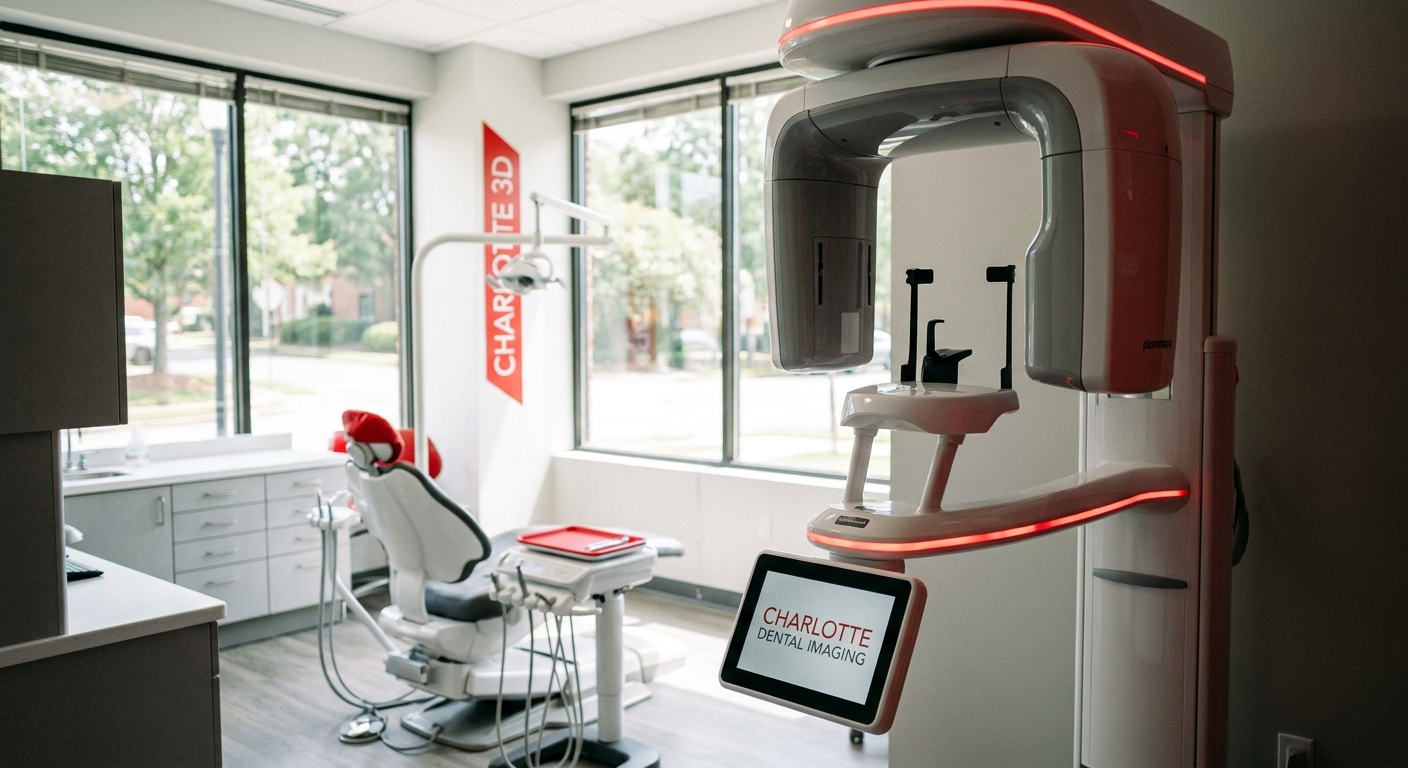
For the far more common case, a throbbing, swollen, feverish tooth that has not yet reached that stage, same-day care in the office may be the right answer. Once you are brought back, a cone-beam CT scan, the practice’s 3D X-ray, is captured to look for infection at the root ends, large cavities, and changes in the surrounding bone. The doctor then confirms the source with a thorough intraoral exam, tests tooth vitality with percussion and cold, drains the pressure when indicated, treats the tooth with a root canal or extraction depending on the case, and prescribes antibiotics when needed. The single takeaway is simple: fever or a swelling face never waits for Monday. Infection does not keep business hours, and neither should your decision to be seen.
Cracked and Fractured Teeth: Why the Surface Fools You
A cracked tooth can be an emergency even when it looks perfectly fine, because the most serious cracks run down into the root where you cannot see them and a standard flat X-ray often cannot either. Surface appearance is one of the least reliable guides you have.
A chip you can feel with your tongue is usually visible damage to the crown. A vertical root fracture is the opposite. The tooth may show almost nothing, yet a split has traveled down the root, opening a pathway for bacteria and setting off pain that comes and goes with pressure. The difference matters because a vertical root fracture generally cannot be saved, and every day it sits there, infection and bone loss around the root may worsen. This is where the diagnostic tool decides everything. A traditional two-dimensional X-ray flattens the tooth into a single image and can miss a hairline split entirely. A cone-beam CT scan builds a three-dimensional picture, so a fracture hiding at an angle may show up more clearly.
Consider one patient who walked in on a Tuesday morning with excruciating lower-left pain. A cone-beam CT scan captured minutes later revealed an unrestorable vertical root fracture of tooth #30, the lower first molar, with the diagnosis confirmed by clinical exam. After anesthesia made the area numb and pain-free, a careful extraction and a bone graft to preserve the site for a future implant were completed, and the patient left that morning. The lesson is uncomfortable but useful: a tooth that feels merely “off” can already be beyond saving in some cases, and only proper imaging tells you which situation you are in.
Lost Fillings and Crowns: How Fast Does the Damage Start?
A lost filling or crown feels cosmetic at first, but exposed inner tooth structure can begin harboring bacteria and potential infection within about 24 to 72 hours in some cases, depending on multiple factors. What looks like a minor annoyance is really an open wound.
The reason is the anatomy underneath. A crown or filling seals off dentin, the softer layer beneath the enamel, which is threaded with thousands of microscopic tubules leading straight toward the pulp. Once that seal breaks, bacteria, sugar, and temperature swings pour into those channels. Cold coffee suddenly makes you wince, and given a few days, that irritation can turn into decay or an infection that was not there when the crown fell out. This is why “I will just glue it back with drugstore cement and deal with it next week” can sometimes backfire. If decay is already growing under the crown, re-cementing it simply traps the problem in the dark.
At Charlotte Emergency Dental, a lost crown, a loose crown, and lingering sensitivity are handled the same day when patients walk in, and before anything is re-cemented the tooth is scanned with the cone-beam CT to check for hidden decay or infection underneath. If the tooth is clean, the crown may go back on. If bacteria have already gotten a foothold, the team treats the underlying problem first, which is the whole point of looking before sealing. Getting in within a day or two, rather than riding it out, may help keep a small repair from becoming a root canal, though outcomes vary.
Post-Extraction Pain and Dry Socket
Throbbing, deep pain that shows up two to four days after a tooth is pulled, and that over-the-counter medication barely dents, is very often dry socket, and it may count as an emergency because you cannot manage it at home. This is one of the more miserable dental pains there is, and it has a specific approach.
The clinical name is alveolar osteitis. After an extraction, a blood clot is supposed to form in the socket and shield the raw bone and nerve endings underneath while everything heals. When that clot dislodges too early, whether from vigorous rinsing, a straw, or simple bad luck, the bone is left exposed to air, food, and temperature. That is why ibuprofen and acetaminophen feel less effective. The pain is not coming from inflamed tissue they can quiet, it is coming from bare nerve endings in an open socket, and no pill reaches that directly.
The treatment approach is mechanical. Charlotte Emergency Dental treats dry socket and post-extraction pain in-office the same day, with no referral. The doctor gently cleans the socket and packs it with a medicated paste that coats the exposed bone, which may bring relief within minutes in some patients, and prescribes antibiotics if there is any sign of secondary infection. The dressing is refreshed as needed while the site heals. If you had a tooth out recently and the pain suddenly spikes days later instead of easing, do not wait it out. Walk in.
What Does Not Count as an Emergency, and What to Do Instead
Plenty of dental problems feel urgent in the moment but may be genuinely safe to wait a day or two for a scheduled visit, as long as they pass those three tests in reverse: no immediate threat to the tooth’s survival, no uncontrolled bleeding or swelling, and no pain that stops you from eating, working, or sleeping.
A small chip with no pain and no sharp edge may fall here. So does mild sensitivity to cold that fades quickly and comes with no swelling. A loose orthodontic wire poking your cheek is annoying, not dangerous, and a bit of orthodontic wax pressed over the end usually holds you until you can be seen. A crown that stays put but feels slightly high, a food trap that keeps catching floss, and a dull ache that responds fully to ibuprofen and does not return are all real reasons to book an appointment soon, not necessarily reasons to interrupt your Saturday night.
There is one clean rule that cuts through the doubt. If the problem wakes you at night, or keeps you from eating or getting through your workday, it may count as a dental emergency no matter how small it looks, and if it does neither, it can often wait a day or two. When in doubt, a quick phone call settles it, because the front-desk team triages exactly this question all day. One more line to draw clearly: major facial trauma, a fractured jaw, and rapidly spreading swelling that affects breathing or swallowing are hospital emergencies, not dental-office visits, and they belong in an ER. For tooth and bone problems that need a dental chair, the office may be the right and less expensive destination.
How Much Does Emergency Dental Cost in Charlotte, and Can You Get Seen Today?
The emergency exam with X-rays at Charlotte Emergency Dental is $99, treatment costs vary by procedure, and in most cases patients can be seen the same day, seven days a week, with no appointment. Cost and access are the two barriers that make people hesitate on a weekend, so both are worth spelling out plainly.
On money: the practice is out of network and self-pay, which means you pay at the visit, and the office hands you itemized insurance claim forms to submit to your insurer for possible reimbursement afterward. For larger treatment like a root canal, crown, or extraction, Charlotte Emergency Dental works with a variety of third-party financing companies that let you break the total into multiple monthly payments, frequently at 0% interest on approved credit. That structure exists for a simple reason: cost should not be what makes you lose a tooth you might have been able to save. Knowing the $99 exam price up front, and knowing a payment plan is on the table, takes the guesswork out before you ever walk in.
On access: walk-ins are welcome every day of the week, with extended weekday hours of 10 a.m. to 7 p.m., which puts the practice open about 75% more than an office running Monday through Thursday only. On weekdays, many patients go from walk-in to the start of treatment in about 30 minutes, and on weekends the wait is often under an hour, though times can vary. Compare that to a hospital emergency room, where a toothache can mean a multi-hour wait, a larger bill, and often only pain medication and a referral, because ERs are not equipped to fix or reimplant teeth. A problem that belongs in a dental chair may be treated faster and more completely in one.
Common Questions About Dental Emergencies in Charlotte
Can a toothache wait until Monday if it started on Friday night?
If over-the-counter pain medicine controls it and you have no fever or facial swelling, waiting until Monday may be safe. But if the pain wakes you from sleep, or you notice any swelling, same-day care may help keep the infection from spreading into bone or the soft tissue of your face, where it can become harder to treat. Charlotte Emergency Dental is open all weekend, so you do not have to gamble on it holding until Monday.
How much does a dental emergency visit cost in Charlotte?
Charlotte Emergency Dental charges $99 for the emergency exam and X-rays. Treatment beyond that depends on the procedure. The practice offers third-party financing, often at 0% interest on approved credit, so you can start treatment the same day and pay over time instead of delaying care over the bill.
Should I go to the ER or a dentist for a knocked-out tooth?
Go to a dentist with same-day availability. Hospital ERs rarely have the materials or training to reimplant a tooth, so they usually stabilize you and send you to a dentist anyway. Place the tooth in milk and call Charlotte Emergency Dental as quickly as possible, ideally within the first 60 minutes, for the best chance of attempting to save it; the team will walk you through the steps on the phone.
What is the difference between a cracked tooth and a broken tooth?
A break shows visible missing tooth structure you can usually see or feel. A crack can be invisible on the surface yet run deep into the root, which often requires a cone-beam CT scan to find. Both can be emergencies if they expose the pulp or cause severe pain, but a vertical root fracture frequently means the tooth cannot be saved.
Do I need an appointment for a dental emergency in Charlotte?
No. Charlotte Emergency Dental welcomes walk-ins seven days a week with no appointment required and starts treatment for many weekday patients within about 30 minutes, though times vary. That removes the delay of waiting for a callback or the next open slot while you are in real pain.
How do I know if my tooth infection is spreading?
Watch for fever, visible swelling in the gum or face, pain radiating into the jaw or ear, and any difficulty swallowing. Those signs may mean the infection has moved beyond the tooth into the surrounding tissue and may need same-day drainage and antibiotics. Trouble breathing or swallowing is a hospital emergency, so go to an ER for that (Dental emergencies, PMC, NIH).
If you are experiencing severe tooth pain, facial swelling, or trauma and may need same-day care, call Charlotte Emergency Dental at (704) 525-3939 or walk in seven days a week. Many patients start treatment within 30 minutes on weekdays, and the $99 emergency exam with X-rays, plus 0% financing options, means cost does not have to delay the care that may help save your tooth. Remember the rule that decides everything when you are unsure what counts as a dental emergency: if it steals your sleep, your meals, or your peace of mind, it may be worth walking in today.
Not Sure If Your Symptoms Qualify?
When you’re dealing with sudden tooth pain, a knocked-out tooth, or unexpected bleeding, the uncertainty can be just as stressful as the discomfort itself. Charlotte Emergency Dental is here to help you make the right call, and our team can quickly assess your situation over the phone to determine whether you need immediate care. You don’t have to figure this out alone.
Call Charlotte Emergency Dental
Outcomes vary by individual, and clinical examples described here reflect specific patient experiences, not a promise of any particular result.