Cracked Tooth? Symptoms, Risks, and Same-Day Care in Charlotte
On a recent Tuesday morning at Charlotte Emergency Dental, a patient walked in at 10:15 a.m. in excruciating pain from a cracked molar. The team captured a CBCT scan by 10:30. The patient was numbed and out of pain by 10:35, just five minutes later. By 11:20 the fractured tooth was out and a bone graft was placed, and the patient was driving away by 11:30. That is 75 minutes from arrival to departure, because a cracked tooth does not wait politely for next week’s appointment, and neither does this practice, which treats almost 100% of emergencies the same day.
If you just felt a sharp jolt when you bit down, or ran your tongue over a jagged edge that was smooth this morning, you are in the right place. This guide explains what a cracked tooth actually is, why it can turn serious fast, and exactly what happens when you walk in for same-day care in Charlotte, NC.
What Is a Cracked Tooth and How Do You Know You Have One?
A cracked tooth is not one single problem. It sits on a spectrum. Dental fractures range from craze lines, which are superficial enamel cracks that need no treatment, all the way to vertical root fractures, which cannot be saved. In between are chipped cusps, cracks that travel toward the pulp, and split teeth. Where your tooth falls on that spectrum decides everything about your treatment, and the good news is that the symptoms you feel already give strong clues.
The symptoms tell the story. Sharp pain when you release a bite, rather than when you press down, is a classic sign of a crack. As you chew, the cracked segments spread apart slightly, then snap back when you let go, and that rebound is what sends the jolt through the tooth. Lingering sensitivity to cold that hangs on for several seconds points to deeper involvement, closer to the nerve. Pain that comes and goes on its own, with no clear trigger, suggests the crack has reached the pulp inside the tooth. The depth of the crack is what you are really trying to learn, because it separates a tooth that a crown can rescue from one that needs a root canal first.
It helps to know how a crack differs from a chip or from decay. A chip breaks a visible piece away and usually feels rough but not painful. Decay is a slow softening of the tooth by bacteria, and it aches over weeks, not seconds. A crack is often invisible to the naked eye and to the patient, which is the frustrating part. You may feel the pain clearly yet see nothing in the mirror. That is exactly why a cracked tooth needs imaging rather than guesswork, and why a cracked tooth dentist relies on tools that show what your eye cannot.
Why a Cracked Tooth Cannot Wait Out the Weekend
A crack is not stable. Every time you chew, the fracture is under load, and under that pressure it deepens a little more. What starts as a hairline in the enamel can travel down toward the root, and once it reaches the pulp chamber, the situation changes from mechanical to biological. A crack that reaches the pulp introduces bacteria and can lead to a dying nerve and infection at the root tip within a few days. In plain terms, the living tissue inside the tooth can die and become infected in a matter of days.
That short window is why timing matters so much. A tooth that could have been saved with a crown on Friday can become an abscess by Sunday and an extraction by Monday. The infection does not stay put either. It builds pressure at the root tip, causes throbbing pain that wakes you at night, and can spread into the surrounding bone. What was a manageable problem becomes a painful, more expensive one, and sometimes an unsavable one.
Same-day diagnosis is what breaks that chain. At Charlotte Emergency Dental, the CBCT scan shows whether the fracture is still shallow enough for a crown or has already extended below the gumline, and it also reveals infections and the state of the surrounding bone. That information decides whether you keep the tooth or lose it. Waiting to “see if it settles down” gives the crack more time to travel and more time for bacteria to reach the nerve. When you catch a crack early, you protect your options. When you wait, the crack narrows them for you.
From Walk-In to 3D Scan to a Real Plan in Under 30 Minutes
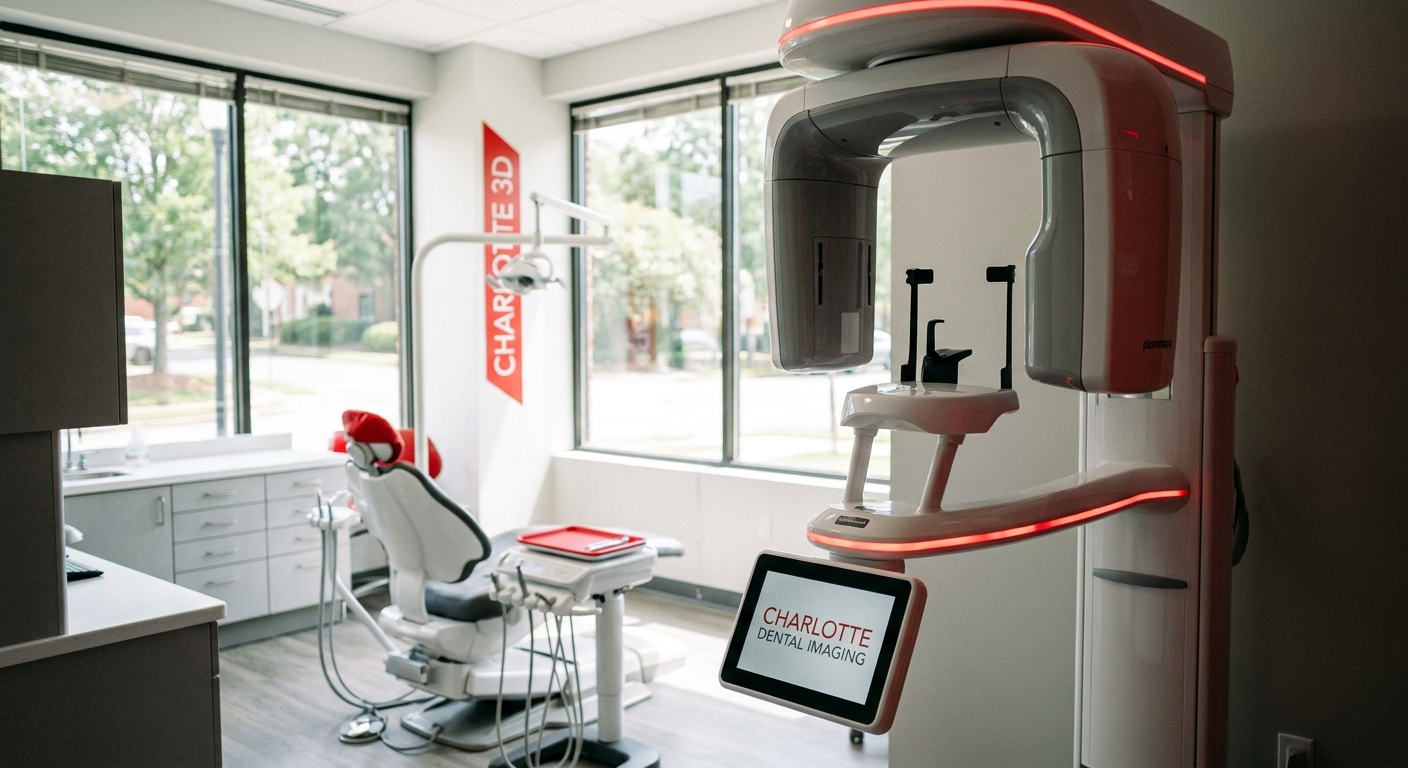
The visit is systematic, not improvised. Charlotte Emergency Dental uses cone-beam computed tomography, or CBCT, to capture cross-sectional slices of the tooth and the bone around it. This reveals fracture lines that run vertically through the root or horizontally across the crown, detail that is invisible on a traditional two-dimensional X-ray. A flat X-ray can hide a crack behind overlapping structures, while a 3D scan looks at the tooth from every angle, so a fracture line that would otherwise be missed shows up clearly.
Here is how the process actually flows. Front-desk triage comes first, so the team knows which tooth hurts and how urgent it is. CBCT capture happens within minutes, not hours. The dentist then reviews the scan right there in the operatory and performs vitality testing on the tooth. That testing includes percussion, a gentle tap to see how the tooth responds, and a cold test, which checks whether the nerve is healthy, inflamed, or already dying. Those simple tests, paired with the 3D image, confirm exactly how deep the crack runs and whether the pulp is involved.
Then you get an answer. Before you leave the chair, the dentist delivers the treatment plan, whether that is a crown, a root canal, an extraction, an implant, a bridge, or a denture. On a weekday, this diagnostic phase completes fast: the Tuesday patient described above went from arrival to a confirmed CBCT diagnosis in about 15 minutes, and typical weekday walk-in time from arrival to treatment runs around 30 minutes. You are not sent home to think it over for a week while the crack deepens. You know what is wrong, what it will take to fix it, and what it will cost, all in one sitting. That clarity is the whole point of same-day care, and it is what turns a scary unknown into a decision you can actually make.
Crown, Root Canal, or Extraction: Which Crack Needs Which
Most cracked teeth that still have healthy pulp and stable cusps can be restored the same day with a crown at Charlotte Emergency Dental. The decision is not complicated once the imaging is in front of you. Hairline craze lines in the enamel often need only monitoring. Cracks that run through the crown but spare the nerve get a crown to hold the tooth together. Cracks that reach the pulp need a root canal before the crown. And vertical root fractures that split the root below the gumline cannot be restored at all.
When a Crown Alone Saves the Tooth
If the crack is contained in the crown of the tooth and the pulp is still healthy, a crown is the fix. Think of a crown as a helmet that caps the tooth and holds the cracked segments together so they can no longer flex and spread when you chew. Because the fracture can no longer move, the pain of biting stops, and the tooth is protected from deepening. This is the best-case outcome, and it is why getting seen early matters so much. A crack caught before it reaches the nerve is a crown case, while the same crack caught a few days later, after bacteria have reached the pulp, becomes a root canal case first. Speed keeps you in the simpler category.
When a Root Canal Must Come First
When the crack has reached the pulp and you feel lingering cold sensitivity or throbbing pain, the nerve is involved and a root canal is needed before the crown. A root canal removes the damaged tissue inside the tooth, disinfects the space, and seals it, which ends the pain and stops the infection. Only then does the crown go on top. The reassuring part is that both procedures happen in-office the day you arrive. Charlotte Emergency Dental completes most root canals in-house and refers only challenging canal anatomy to a specialist, which is exactly the kind of judgment you want.
Vertical root fractures are the exception. These extend below the gumline into the bone and cannot be restored. In one documented case, the team diagnosed tooth #30, a lower molar, by CBCT as an unrestorable vertical root fracture, then removed the tooth and placed a bone graft in the same 75-minute visit to preserve the socket for a future implant. Losing a tooth is never the goal, but when it is unavoidable, handling the extraction and graft in one visit keeps your future options open.
Pain Management and Anxiety Relief During Same-Day Care
Fear of the procedure is real, and it keeps people from getting the help they need. If you are anxious about the pain or about the dental work itself, Charlotte Emergency Dental can prescribe anxiolytic calming medication to take before your appointment so you arrive more at ease. This is planned ahead, not improvised in the chair, which means you can walk in relaxed rather than white-knuckling the wait.
Comfort during the work itself comes from fast, effective numbing. Local anesthetic is delivered within minutes of diagnosis, so the extraction, root canal, or crown preparation proceeds without discomfort. You do not lie there in pain while the team debates a plan. The plan is already made, and the numbing follows right behind it.
The Tuesday case shows exactly how quickly this happens. That patient arrived in severe pain at 10:15 a.m., the CBCT confirmed a vertical root fracture by 10:30, and the patient was numbed and out of pain by 10:35, just five minutes after the diagnosis. From the moment the problem was confirmed, relief was minutes away, not days. That is the difference between a practice built for emergencies and one squeezing you into a schedule built for cleanings.
Cost, Financing, and What Your First Visit Really Costs
Cost uncertainty is one of the biggest reasons people delay care, so here are the real numbers. The emergency exam and X-ray fee at Charlotte Emergency Dental is $99. That fee gets you the CBCT imaging, the vitality testing, and a clear diagnosis, so you know what you are dealing with before you commit to anything further.
Definitive treatment cost depends on the severity of the crack. Composite bonding handles a minor chip, while a crown is needed if the tooth structure is compromised. An extraction, with an optional bone graft, is the path if the fracture extends below the gumline. Because each crack is different, the honest answer is that your cost tracks the depth of your fracture, which is exactly why the imaging comes first.
Money should not force you to leave a treatable crack untreated. Charlotte Emergency Dental is a self-pay practice and works with third-party financing companies that break payments into monthly installments, often at 0% interest. That means the decision to fix a cracked tooth the day you discover it does not hinge on the cash in your pocket. You can get out of pain now and spread the cost over time, which is far cheaper in the long run than letting a crown case slide into an extraction and implant.
Why Seven-Day Walk-In Access Matters When a Tooth Cracks
Cracks rarely happen at a convenient time. They show up on a Friday night popcorn kernel, a Sunday afternoon ice cube, or a Saturday morning bagel. Because Charlotte Emergency Dental is open seven days a week with walk-ins welcome and no appointment required, a cracked tooth found on a weekend receives the same imaging, diagnosis, and treatment as a Tuesday morning case. That prevents the fracture from deepening over a long weekend and escalating from a crown case to an extraction.
This is where seven-day access does its quiet, important work. Weekday hours run from 9 a.m. to 7 p.m., roughly 75% more availability than a typical Monday-through-Thursday practice, and weekends are covered too. A practice that closes Friday afternoon and reopens Monday leaves that crack unsupervised for two full days of chewing forces and bacterial exposure. A practice open every day closes that gap, so there is a real place to go regardless of when the pain starts.
Volume matters here as well, because it reflects experience. The team sees around 50 emergency patients a week, with 10 to 15 same-day emergencies a day, including cracked teeth that need same-day implant placement, and a typical weekend walk-in runs under an hour from arrival to treatment. That means you are not walking into an unfamiliar routine. Cracked teeth, toothaches, and urgent dental issues are the daily work here, and the workflow is built around getting you seen, diagnosed, and out of pain fast. This is what a cracked tooth dentist who works in emergencies every day can offer that a general schedule cannot.
Frequently Asked Questions
Can a cracked tooth heal on its own?
No. Enamel and dentin cannot regenerate, so a crack will not close or repair itself. It needs professional restoration to prevent the fracture from deepening and bacteria from reaching the pulp. Waiting only gives the crack more time to spread under normal chewing.
How do I know if my cracked tooth needs a root canal or just a crown?
Lingering sensitivity to cold, spontaneous throbbing, or pain that wakes you at night signals that the pulp is involved, which usually means a root canal before the crown. A crack that hurts only when biting, without lingering pain, may need only a crown. A cracked tooth dentist confirms with percussion and cold vitality tests plus CBCT imaging.
What happens if I wait to treat a cracked tooth?
The crack deepens under chewing forces, bacteria enter the pulp and trigger infection or an abscess, and a tooth that a crown could have saved may require extraction within days. Early treatment protects your options, while delay narrows them.
Does Charlotte Emergency Dental accept walk-ins for cracked teeth on weekends?
Yes. The practice is open seven days a week with no appointment required, and a typical weekend walk-in runs under an hour from arrival to treatment.
How much does it cost to fix a cracked tooth in Charlotte?
The emergency exam and X-ray fee is $99. Definitive treatment ranges from composite bonding for a minor chip to crowns, root canals, or extractions depending on fracture depth. Third-party financing is available, often at 0% interest.
Will I be in pain during treatment for a cracked tooth?
No. Local anesthetic is delivered within minutes of diagnosis, and anxious patients can receive prescribed anxiolytic medication to take before the appointment so the procedure proceeds without discomfort. In the documented Tuesday case, the patient was out of pain five minutes after diagnosis.
Get Your Cracked Tooth Diagnosed and Treated Today
If you have a cracked tooth or suspect a fracture, walk into Charlotte Emergency Dental today, no appointment needed, for same-day CBCT imaging, diagnosis, and treatment. Call ahead to confirm walk-in availability, and ask about calming medication if you are nervous about the procedure. Here is the one thing to act on right now: stop chewing on that side of your mouth until you are seen, because every bite spreads the crack, and the tooth you can save today may not wait until next week.