Emergency Dental Without Insurance in Charlotte: Self-Pay Care and Pricing
You call three dental offices Tuesday morning with a throbbing abscess, and the receptionist at each one asks the same question before anything else: “Who is your insurance carrier?” When you say you are paying out of pocket, the tone shifts, and suddenly appointments disappear, estimates turn vague, and one office tells you to try the ER.
Getting emergency dental without insurance should not feel like a locked door. At Charlotte Emergency Dental, around 50 uninsured patients walk in every week, and the first question is never about your payment method. It is “Where does it hurt?” This guide lays out what self-pay care costs here, what drives the price, how financing works, and what you may hand over at the front desk, so you can walk in knowing the number before you sit in the chair.
What Does Emergency Dental Without Insurance Actually Cost in Charlotte?
An emergency visit here starts at a flat $99 for the exam and X-ray, and treatment prices climb from there based on what the tooth needs. That $99 is the concrete entry point, the fee you pay to get diagnosed and hear your real number, not a vague “it depends” you have to chase.
From there, the ladder is straightforward. A filling to seal a cracked or decayed tooth generally lands between $150 and $400. A tooth extraction runs $200 to $600, depending on whether it lifts out cleanly or needs surgical work. When an infection has reached the nerve and the tooth can be saved, a root canal typically runs between $800 and $1,500 at this practice, the back molars with their multiple curved canals sitting at the higher end, front teeth with single roots at the lower. A crown to rebuild and protect a badly damaged tooth costs $1,200 to $2,500. And when a tooth is lost or cannot be saved, a full implant replacement typically totals $3,000 to $5,000.
Why publish these ranges when most Charlotte practices will not? Because uninsured patients research price for hours before they call, and vague answers only deepen the fear. This team treats 10 to 15 same-day emergencies a day, so these are not scraped national averages. They are the numbers real Charlotte patients pay at this front desk. Knowing them turns a panic-inducing unknown into a decision you can plan around, financing included.
Why Does a Molar Root Canal Cost Seven Times More Than a Front-Tooth Extraction?
The price gap comes down to time, tools, and complexity. Pulling a loose front tooth might take fifteen minutes and a single instrument, while working on a back molar can take an hour of precise work through multiple tiny canals, plus a temporary crown to protect it afterward.
Picture a simple front-tooth extraction. The tooth has one root, the access is easy, and once you are numb the tooth lifts out in minutes. That is the low end of the $200 to $600 range. Now picture a lower molar with three curved canals feeding an infected nerve. The dentist has to open the tooth, clean and shape each canal with specialized files, disinfect the space, seal it, and then cap it so it does not fracture under your bite. One canal versus three, fifteen minutes versus an hour, a single-root extraction versus a multi-canal cleanup with a temporary restoration, that is why the prices sit where they do. Most of these root canals are completed in-office here; cases with particularly challenging canal anatomy may be referred to a specialist.
Materials drive cost too. A crown may be milled from a ceramic block or built by a dental lab, and either way you are paying for a custom-fitted restoration. An implant is really three parts: the titanium post that fuses to your jaw, the abutment that connects to it, and the final tooth on top. Each stage adds material and precision, which is why implants top the list. Understanding what your money buys makes the number feel earned instead of arbitrary.
How Financing Turns a $1,500 Root Canal Into $125 a Month
You do not have to pay a large treatment cost in one lump sum. Charlotte Emergency Dental works with several outside lending partners that let you split the bill into multiple monthly payments, and many plans carry 0% interest on approved credit. That $1,500 root canal becomes roughly twelve payments of $125 instead of a single checkout shock.
The mechanics are simple and fast. You apply online or by phone during your visit, usually in about five minutes. Approval commonly requires a credit score in the neighborhood of 600, and once you are approved the funds are available immediately, so treatment can move forward the same day rather than waiting on a wire or a second appointment.
Consider what that means in practice. A patient who could never write a $2,700 check for a root canal and crown may be able to manage a fixed monthly payment that fits a paycheck. The pain can be addressed today, and the cost gets spread across the year on terms you agree to before anyone touches your tooth. If your credit does not clear the standard threshold, ask about the range of partners the practice uses, since terms and approval requirements vary from lender to lender.
Can You Get Money Back From Your Insurer After Paying Out of Pocket?
Often, yes. Out-of-network does not mean zero coverage. If you carry any dental plan, many North Carolina policies may reimburse a portion of the usual and customary fee for major restorative work, even when the dentist is not in your network.
Here is how it works at this practice. Charlotte Emergency Dental is a self-pay, out-of-network office, so you pay for care at the time of treatment. But the front desk provides you an itemized insurance claim form with the procedure codes and X-rays your insurer needs. You submit that paperwork to your plan, and depending on your annual maximum, deductible, and how your plan categorizes the work, a check may land in your mailbox weeks later covering a share of what you spent.
That distinction matters enormously for people who assume “no insurance card on file” equals “no help at all.” A patient who pays $1,200 for a root canal out of pocket might recover several hundred dollars afterward by filing the claim the office hands them. Coverage varies by plan, and no one can promise a specific reimbursement, so read your policy’s category rules and annual maximum. But do not leave that money unclaimed. If you have any dental benefits at all, filing the paperwork after an out-of-pocket emergency visit may help lower your true cost.
What Delaying Treatment Can Mean
Waiting can be an expensive choice. A tooth that needs a $200 extraction today can, within a week, develop complications that require more extensive care. Dental problems typically do not resolve on their own.
Cost is the reason many adults put off dental care, and it is a painful irony, because delay often makes care more complex. An abscess does not stay put. Left alone, infection can move into the surrounding tissues of your jaw and face, and once it reaches that point you are no longer looking at a routine extraction. You may be looking at additional procedures, hospital-grade antibiotics, and a recovery that takes more time and money than the original tooth would have. Severe swelling that could compromise your airway is exactly the kind of case this practice stabilizes and may send straight to the emergency room. Same-day treatment exists to address problems before they progress.
If money is the wall standing between you and care, do not simply wait it out. North Carolina operates a network of safety-net dental clinics for residents who need reduced-cost help, and the federal government maintains a directory of low-cost dental care options as well. Charlotte Emergency Dental treats 10 to 15 same-day emergencies a day, with a typical weekday wait of about 30 minutes from walk-in to treatment and under an hour on weekends.
What Happens From the Moment You Walk In
You arrive in pain, and you are seen quickly. On a typical weekday, about 30 minutes pass between walking through the door and being in the chair receiving care, and there is no insurance verification gauntlet to clear first.
The sequence is built for someone hurting and worried about money. You fill out a short intake form, and no one asks for a carrier or a member ID before care, because this is a self-pay practice. You see the dentist, get your exam and X-ray for the flat $99, and hear a diagnosis along with the full cost of treatment before anything begins. Then you decide: pay and proceed, or set up financing on the spot and proceed anyway. Either way, the goal is to address the problem in that single visit, not to send you home with a referral and a follow-up appointment across town.
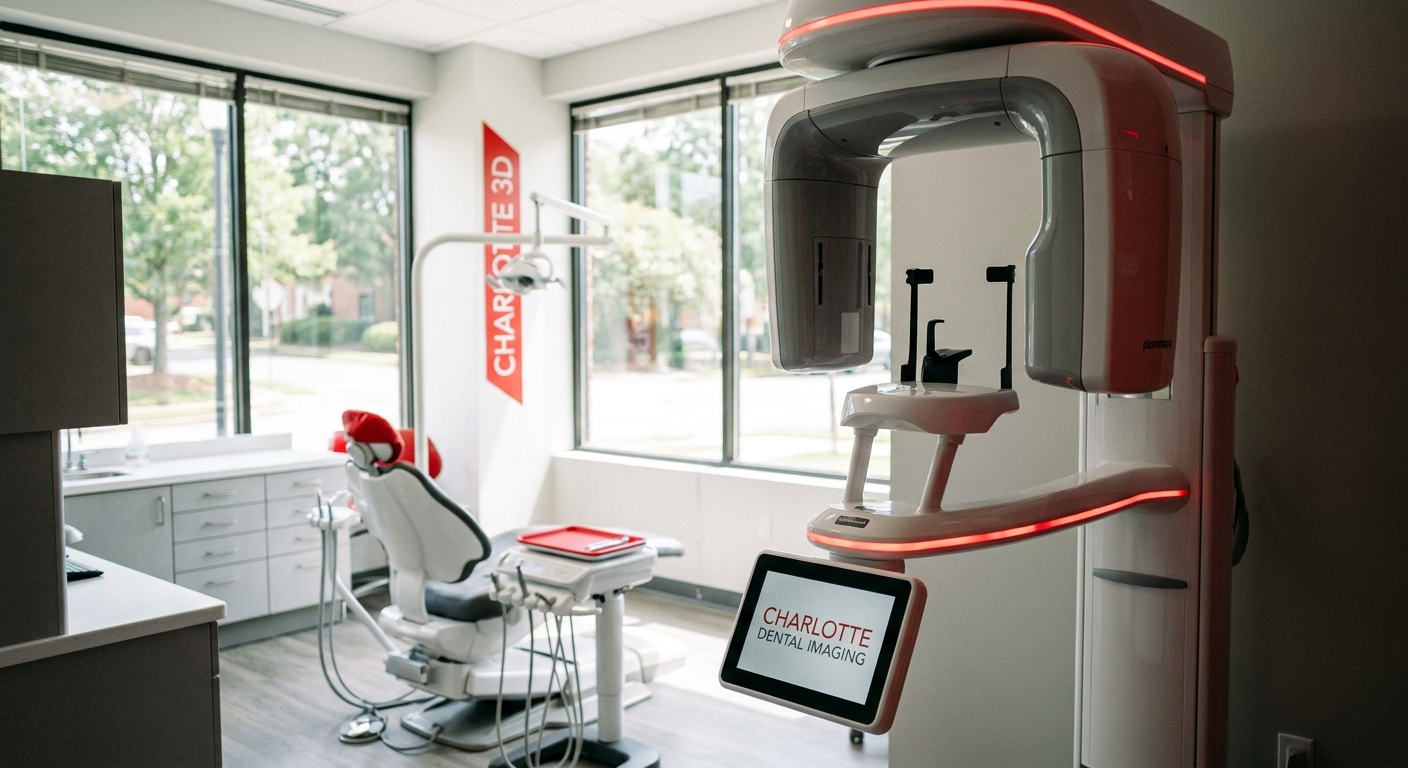
One example shows how quickly this can move. A patient arrived at 10:15 a.m. on a Tuesday with severe lower-left pain. A CBCT scan and diagnosis were done by 10:30, the patient was fully numb by 10:35, and an extraction with a bone graft was finished by 11:20. They were out of the parking lot by 11:30. Around 50 uninsured walk-ins come through these doors each week, and the first question is always about your pain, never your payment method.
Which Emergencies Can Be Treated Here, and Which Get Referred Out?
Nearly every common dental emergency is handled same-day and in-house. That includes severe toothaches, abscesses, knocked-out teeth, broken teeth, infections, lost or loose crowns, extreme sensitivity, dry socket, post-extraction pain, and emergency root canals. Most root canals are completed right here.
For a knocked-out permanent tooth, the response is immediate and specific. You are told to keep the tooth in milk on your way in, then the team seats you right away, numbs the area, gently cleans off debris, and works to reimplant the tooth. The tooth is splinted to the neighboring teeth to stabilize it, and you leave on a ten-day antibiotic course, typically amoxicillin, to protect the healing site. Time is critical when addressing tooth avulsion.
Just as important is knowing the limits, because honesty about them is what tells you this is a real dental practice. A handful of cases are stabilized and referred rather than treated in-house: root canals with particularly challenging canal anatomy may go to a specialist, major facial trauma and fractured mandibles belong in a hospital setting, and life-threatening swelling that could compromise your airway is sent straight to the emergency room. Good clinical judgment means treating what should be treated here and routing the rare exception to the right place, fast.
Why Seven-Day Access Matters When You Are Paying Yourself
Charlotte Emergency Dental is open seven days a week with weekday hours from 9 a.m. to 7 p.m., so you can come in after your shift instead of surrendering a full day’s pay. For an uninsured patient working an hourly job, losing wages to sit in a waiting room is its own kind of bill.
Think about the math a traditional Monday-through-Thursday office forces on you. Being open seven days offers significantly more availability than those standard schedules. If you can only be seen during standard business hours, you either clock out and lose the income or you wait until the weekend, by which point the problem may have progressed. Evening hours change that equation. You finish work, drive over, and can be treated the same day without punching a hole in your paycheck. When you are covering the full cost yourself, protecting your income is part of protecting your budget.
Weekends are where extended access earns its keep. A dental emergency does not check the calendar, and one that develops on a Saturday afternoon may not be wise to defer until Monday morning. Here, weekend waits usually run under an hour, so a Saturday emergency can be addressed Saturday. Walk-ins are welcome every single day, which means you can seek care when you need it.
What You May Pay at the Front Desk
Here is what three common emergencies may total, with and without financing, so the number stops being a mystery.
Scenario one: a cracked molar that needs extraction. You may pay the $99 exam and X-ray plus a $400 extraction, for $499 total. Spread across twelve months at 0% on approved credit, that is about $42 a month.
Scenario two: an abscessed tooth that may need a root canal and a crown. The $99 exam joins a $1,200 root canal and a $1,500 crown, for $2,799 total. Financed over twelve months, that lands near $233 a month.
Scenario three: a knocked-out front tooth that cannot be saved and may need an implant. The $99 exam plus a $4,200 implant comes to $4,299 total, or roughly $358 a month over a year.
Every one of those totals is a decision you make with the full number in front of you before treatment starts, not a surprise on the way out. And if you carry any dental plan, remember you can still file the itemized claim form afterward and potentially recover a portion of what you paid. The point of all of it, transparent pricing, financing, and out-of-network claim support, is to make sure getting emergency dental without insurance never means staying in pain because you cannot see the cost.
Call Charlotte Emergency Dental or walk in seven days a week for same-day emergency care with transparent self-pay pricing, starting at $99 for exam and X-ray, with 0% financing available to break treatment costs into manageable monthly payments.
Frequently Asked Questions
Can I get emergency dental care in Charlotte without insurance?
Yes. Charlotte Emergency Dental treats uninsured walk-ins, charging a flat $99 for the exam and X-ray, with same-day treatment available for nearly every emergency and financing options that spread larger costs into fixed monthly payments. No insurance card is required to be seen.
How much does an emergency tooth extraction cost without insurance in Charlotte?
A simple extraction runs $200 to $400 self-pay, while a surgical extraction runs $400 to $600, plus the $99 exam and X-ray fee. Financing, often at 0% interest on approved credit, can break the total into monthly installments so you are not paying it all at checkout.
Will my insurer reimburse me if I pay out of pocket at an out-of-network dentist?
Sometimes. Many North Carolina dental plans may provide some reimbursement for major work even when the provider is out-of-network. Charlotte Emergency Dental gives you completed itemized claim forms so you can file for potential partial reimbursement after you pay. Exact amounts depend on your specific plan.
What happens if I delay emergency dental treatment because I do not have insurance?
An untreated dental infection can progress into the surrounding tissues of your jaw and face and may require more extensive treatment including hospitalization for IV antibiotics and surgical drainage. Addressing problems earlier is often less complex than waiting.
Does Charlotte Emergency Dental require payment upfront if I do not have insurance?
The practice sees uninsured walk-ins and typically begins treatment within about 30 minutes on weekdays. You can set up third-party financing during your visit and proceed with same-day treatment.
Can I get a same-day root canal without insurance in Charlotte?
Charlotte Emergency Dental performs emergency root canals the same day for $800 to $1,500 depending on the tooth, and financing may let you spread the cost into monthly payments at 0% interest on approved credit.
Get Relief From Your Dental Emergency Today
When you’re in pain and worried about the cost, waiting only makes both worse. Charlotte Emergency Dental works with patients every day who are navigating emergency care without insurance, and we’ll walk you through your options clearly before any treatment begins. If you’re dealing with a dental emergency right now, a quick conversation can help you understand what to expect and how we can help.
Call Charlotte Emergency Dental
- Individual costs may vary based on your specific needs and circumstances.
- Financing approval and specific terms depend on your individual credit profile and the lender’s requirements.
- Reimbursement amounts vary significantly by plan, and individual results depend on your specific policy terms.
- Treatment times vary based on individual circumstances.
- Outcomes for reimplanted teeth vary significantly depending on time elapsed and individual factors.
- These are examples; your specific costs may differ.
- Your specific cost may vary based on your individual case.
- Reimbursement varies significantly and is not guaranteed.