Choosing a Charlotte Emergency Dentist: Reviews, Wait Times, and What to Expect
You land on five emergency dentist websites in ten minutes, and every single one promises same-day care with a 4.8-star rating, but none of them explains what same-day actually means, whether you might wait three hours in the lobby, whether your specific problem can be addressed today or only diagnosed today, or whether the office even takes walk-ins on weekends the way Charlotte Emergency Dental does.
That is the real problem when you are in pain. The websites all sound alike, the star ratings blur together, and the one thing you cannot tell from a homepage is whether the office in front of you may be able to help you today, or whether you might drive across town only to be handed a referral slip and told to book a follow-up appointment for next week. This guide gives you a simple way to cut through all of it when you need emergency dental care, and it holds one Charlotte practice, Charlotte Emergency Dental, to the same standard so you can see how the criteria work in the real world.
The Verdict: Four Things That Tell You Whether an Office Can Really Handle Your Emergency
If you only have a minute, here is the short version. Four things separate an office that delivers genuine emergency dental care from one that simply uses the word “emergency” in its ads. First, true walk-in access, meaning you can show up without an appointment and without talking your way into a slot. Second, a real wait time from the moment you arrive to the moment treatment starts, published or at least verifiable. Third, the scope of what the office may be able to address in one visit, because diagnosing your problem is not the same as addressing it. Fourth, honest pricing before you sit in the chair, so pain never pushes you into a bill you did not agree to.
Charlotte Emergency Dental addresses all four, and it addresses them with information you can verify rather than slogans. Walk-ins are welcome seven days a week. Weekday patients at Charlotte Emergency Dental typically wait about 30 minutes on average from arrival to the start of treatment, though individual experiences vary. Many cases that come through the door may be addressed in-house the same day when clinically appropriate, with no second trip across town, though some situations require referral or additional visits. And the emergency exam and X-ray fee is posted plainly at $99, with an itemized estimate provided before any work begins.
Use those four criteria on any office you are considering, including this one. If a practice cannot answer all four clearly, keep looking. Pain is a bad time to guess, and a well-organized emergency office will make the answers easy to find. Each of these four criteria is worth understanding in detail before you choose.
Why “We See Emergencies” Usually Still Means “Call and Hope for an Opening”
Here is the trap most people fall into. A Charlotte practice lists emergency care on its website, so you call, describe your throbbing molar, and wait to hear whether a slot exists today. Sometimes one does. Often it does not, because that office runs on a scheduled book that fills up fast, and your emergency has to squeeze into a gap between routine cleanings and crowns. That is not true walk-in access. That is asking permission.
A genuine walk-in office is built differently. The staffing, the rooms, and the daily rhythm are all designed around patients who did not plan to be there. Charlotte Emergency Dental runs on exactly that model, seeing walk-in patients without scheduled appointments. Weekday hours run from 9 a.m. to 7 p.m., so you can come in after work instead of burning a vacation day, and the doors stay open on Saturday and Sunday, when a throbbing tooth is most likely to strike and most offices in the area are dark.
The workflow itself at Charlotte Emergency Dental tells you it was made for walk-ins. Patients are triaged at the front desk, moved back for imaging, evaluated by an assistant, then seen by the doctor, all without an appointment on the calendar. When you read emergency dentist Charlotte reviews, this is the pattern to look for: people describing that they walked in without an appointment, on a weekend or a weeknight, and were taken back for evaluation. A review that says “they fit me in” is a scheduled office bending its rules. A review that says “I just walked in and they took me” is a walk-in office doing what it was built to do.
The Number Almost No Office Will Show You: Wait Time From the Door to the Chair
Wait time from arrival to treatment is a meaningful measure of emergency capacity, and it is also the number almost no practice will publish. Star ratings are easy to collect. A real door-to-chair time is only possible if the office is actually staffed and organized to move people efficiently, which is why so few practices put it in writing.
At Charlotte Emergency Dental, weekday walk-in patients typically average about 30 minutes from the time they arrive to the time treatment begins, though individual experiences may vary based on case complexity and patient volume. Weekends may run busier, but the wait often stays under an hour. These are operational estimates. Consider one recent example at Charlotte Emergency Dental: a patient arrived at 1:56 p.m., was triaged at the front desk, had a full 3D scan captured, and the doctor was in the room for evaluation by 2:09 p.m. The extraction was completed and the patient was ready to leave by 2:35 p.m. That particular visit took 39 minutes from walking through the door to completion, though not every case follows the same timeline.
Compare that to the experience many people describe in reviews of other offices: a long wait in a nearly empty lobby, which usually signals thin staffing rather than a genuine crowd, or being told the problem can be looked at today but addressed later. When you are weighing your options, ask the office directly what their typical walk-in wait is. If the answer is a shrug or “it depends,” that is your answer. A practice that tracks this information and states it plainly is telling you it takes your time, and your concerns, seriously.
Can They Actually Address the Problem Today, or Only Diagnose It?
This is the criterion that catches the most people off guard. An office can see you quickly, take an X-ray, name the problem, and then tell you the treatment happens elsewhere or another day. You leave in the same discomfort you came with, now holding a referral and a bill for the exam. The scope of same-day treatment is what separates a true emergency center from a diagnose-and-refer stop.
Charlotte Emergency Dental may be able to address many cases in one visit when clinically appropriate: root canals, extractions, crowns, implants, bridges, dentures, bone grafts, and even the reimplantation of a tooth that has been knocked out are among the services offered. Many patients may have their concerns addressed in-house, though individual cases vary and some situations require referral. Cases that may be sent to specialists include root canals with unusually calcified or complicated canal anatomy, severely impacted wisdom teeth, and serious situations like major facial trauma, a fractured jaw, or dangerous swelling that belong in a hospital setting. That honesty about the exceptions is a good sign, not a bad one, because it means the same-day option is available for many other situations.
Consider what comprehensive scope looks like in one case. A patient came in to Charlotte Emergency Dental one Tuesday morning with severe pain on the lower left. Imaging showed a vertical root fracture, so the tooth needed to come out. The patient was numbed within about twenty minutes of arriving, and the extraction plus a bone graft to preserve the site for possible future restoration were completed before noon. An office that could only diagnose would have sent that patient home still uncomfortable, still with the fractured tooth, and still waiting. When you read reviews, look for people who describe leaving with their concern addressed when possible, not just an explanation of what is wrong.
**
What a 3D Scan May Reveal That a Flat X-Ray Might Miss
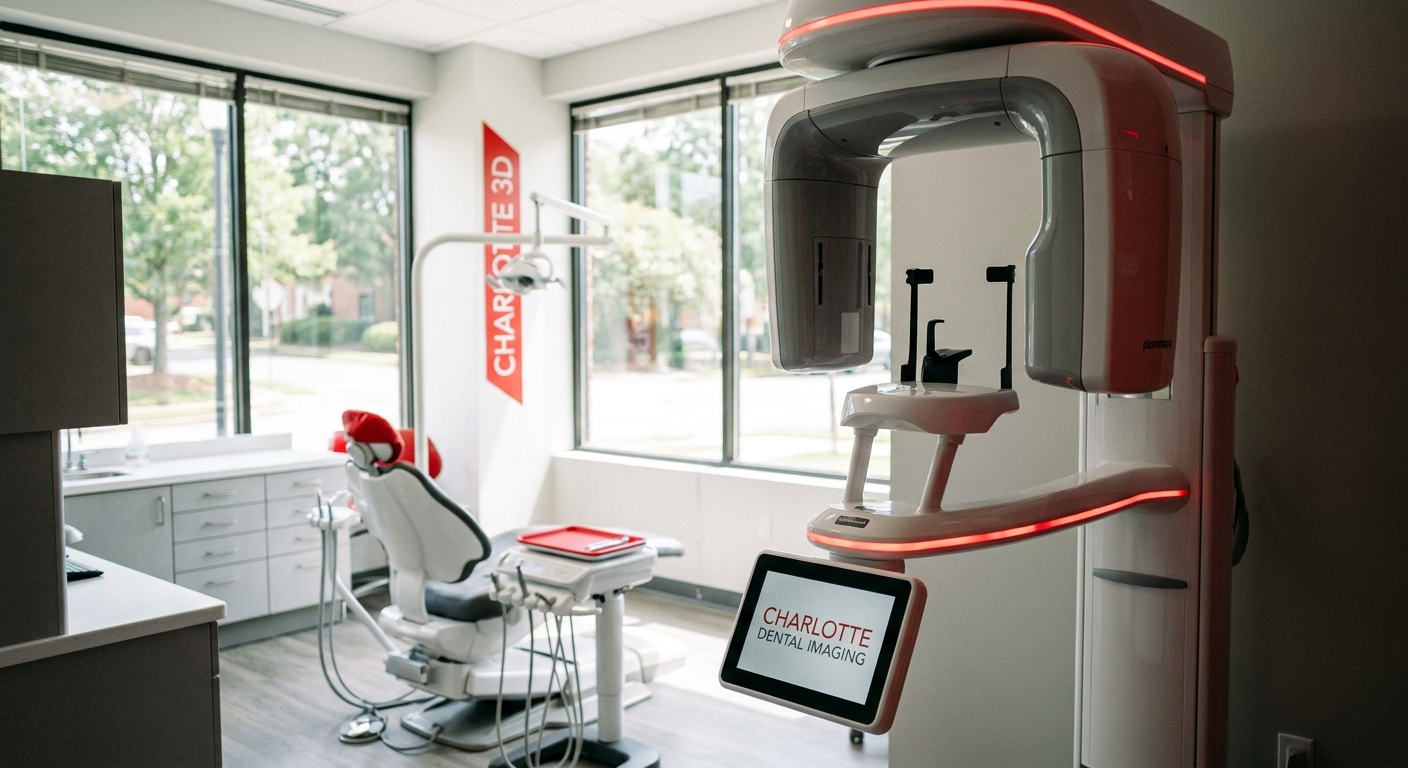
You cannot treat what you cannot see, and in an emergency the quality of the imaging shapes the quality of the decision. Charlotte Emergency Dental uses cone-beam CT (CBCT) for walk-in emergencies. Unlike a standard two-dimensional X-ray used in routine dentistry, a CBCT is a full 3D image that may reveal infections gathering at the tips of roots, cavities hiding below the gumline, hairline fracture lines that flat film may not show clearly, and the amount and quality of bone available if a tooth needs to be replaced with an implant.
The timing is what makes it useful in an emergency. The scan is captured at Charlotte Emergency Dental shortly after triage and reviewed with you on a monitor, so the doctor can show you the source of your concern and discuss your options in the same visit. There is no waiting on a separate radiology report and no referral just to get imaging done somewhere else, which is the kind of delay that turns a one-day problem into a three-appointment ordeal.
This is a diagnostic tool. Peer-reviewed research in the Journal of Endodontics has found that cone-beam CT may detect vertical root fractures and infections at the root tip more accurately than conventional two-dimensional radiographs. In practice, that means a fracture that a flat X-ray might miss may be caught, and you may receive more accurate information the first time. When an office tells you it offers same-day evaluation, ask what imaging it uses. On-site 3D imaging is a strong signal that the office is equipped to evaluate and discuss options in a single visit.
No Surprise Bills After You Are Numb: How Pricing Should Work
Money concern is real, and it gets worse in an emergency, because pain clouds judgment and no one wants to negotiate a bill while their jaw is throbbing. The right office removes that concern before treatment ever starts. Charlotte Emergency Dental posts its emergency exam and X-ray fee plainly at $99, and before any actual work begins you receive an itemized estimate of what the treatment will cost. You know the number before you agree to it, not after the anesthetic wears off.
For patients worried about spreading the cost, the Charlotte Emergency Dental practice works with several outside financing companies that let you break treatment into monthly payments, in some cases without interest. That matters most in the moments when a tooth needs an extraction and an implant, or a root canal and a crown, and the total feels overwhelming at first glance. Having a plan turns “I cannot afford this today” into “I can explore my options.”
Insurance deserves a plain word too. Charlotte Emergency Dental operates on a self-pay basis and is an out-of-network provider, which is a deliberate choice that lets the doctors recommend treatment based on clinical assessment rather than plan restrictions. If you carry a PPO plan, the office provides the itemized claim forms to submit to your insurer for possible reimbursement of a portion of costs. The larger point is one the American Dental Association stresses: fees should be disclosed before treatment so patients can make informed decisions. In reviews, look for people who mention knowing the price up front and facing no surprises. That single detail tells you more about how an office treats patients than any star average.
How to Read Emergency Dentist Charlotte Reviews Without Getting Fooled
A high star count feels reassuring, but on its own it tells you almost nothing about whether an office can address the specific dental issues behind your emergency today. A practice can earn amazing, glowing reviews for gentle cleanings and friendly staff while still sending genuine dental emergencies out the door with a referral. When you scan emergency dentist Charlotte reviews, read the words, not just the number of stars.
The helpful signals are specific. Look for patients who mention being seen quickly as a walk-in, especially on a weekend or in the evening. Look for people who describe receiving treatment the same day when appropriate, such as an extraction, root canal
Individual results vary, and not all conditions can be fully addressed in a single visit.