Charlotte Emergency Dentist: Walk-Ins Welcome Seven Days a Week
You need a dentist now, not next Tuesday, and you have no appointment. Most practices tell walk-ins to try urgent care or wait days for an opening, but Charlotte Emergency Dental built its entire operation around same-day treatment for patients who arrive unscheduled, in pain, and out of options.
What a Charlotte Emergency Dentist Does for Walk-In Patients
A walk-in emergency dentist exists to address urgent dental problems: a tooth that hurts today, on a schedule that will not wait. Charlotte Emergency Dental sees about 10 to 15 same-day emergency patients every day and addresses most of those cases in-house, without sending you to another office across town. That is the whole point of the model. You do not book weeks out, you do not sit in a hospital hallway for hours, and you typically do not leave with only a referral.
Compare that to the two options most people try first. A typical general dental office in Charlotte runs Monday through Thursday, roughly 9 to 5, by appointment only. If your molar flares up on a Friday afternoon or a Sunday morning, that office is closed and the next opening might be next week. A hospital emergency room, on the other hand, is open, but ER staff are set up to manage pain and rule out life-threatening infection, not to fix the tooth itself. You may walk out with antibiotics, a painkiller, and the same broken tooth you walked in with.
The walk-in emergency model closes that gap. Charlotte Emergency Dental sees roughly 50 emergency patients every week, so a walk-in in pain is not an interruption to the day, it is the day. The practice is open seven days a week with extended weekday hours, so the person who cracks a tooth after work on a Wednesday and the person who wakes up with an abscess on a Sunday get the same door and the same access to treatment. Walk-ins are welcome, and the front desk is built to triage you the moment you arrive, whether you come alone or bring a family member in pain.
The Minute-by-Minute Flow from Door to Diagnosis
On a typical weekday, Charlotte Emergency Dental works to move a walk-in patient from the front door through triage, imaging, diagnosis, and treatment in about 30 minutes, though individual experiences vary. Weekend volume can push that closer to an hour when the schedule is busy. Knowing the sequence ahead of time can reduce some of the anxiety around walking in without an appointment.
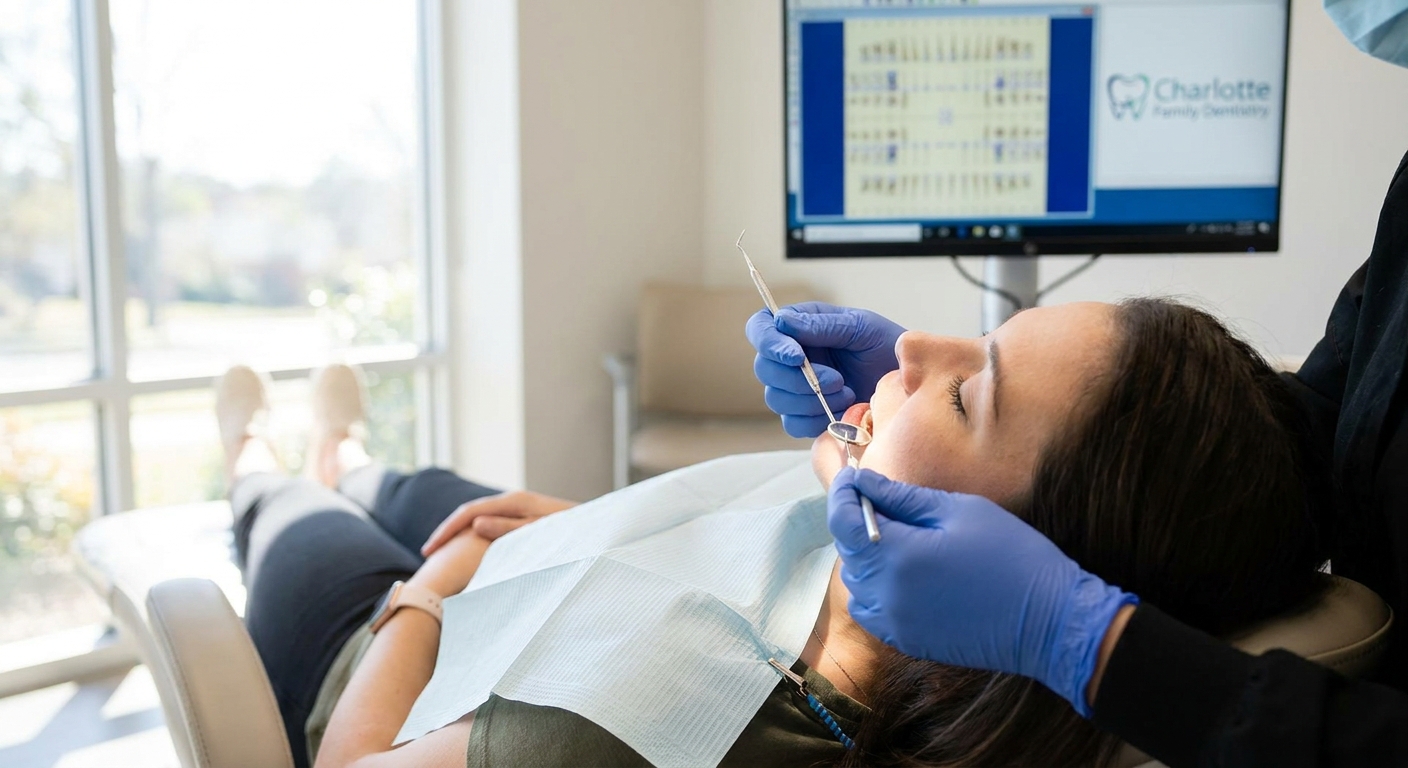
Here is how it typically runs. The moment you arrive, the front desk triages you. They ask about the nature of the problem, and if you are in pain, they ask how long it has lasted, what it feels like, and what makes it better or worse. They also screen for the warning signs of a serious infection, like swelling that affects breathing or swallowing. When possible, you are brought back for a cone-beam CT scan, a 3D image captured on every emergency patient. From there you move into an operatory, where a dental assistant interviews and evaluates you before the doctor arrives. The doctor performs a thorough intraoral exam, tests the tooth’s nerve health with percussion and cold, screens for infection, then reviews your 3D scan with you and points out the likely source of the problem. You see your treatment options and, if you want, your financing options before anything begins.
The documented Monday case shows the pace that is possible. The patient arrived at 1:56 p.m., was triaged, scanned, and had the doctor in the room providing a diagnosis by 2:09 p.m., then completed the extraction by 2:35 p.m. Another patient on a Tuesday arrived at 10:15 a.m. with severe lower-left pain, had a 3D scan and diagnosis by 10:30, received anesthesia by 10:35, and left the parking lot at 11:30 after an extraction and bone graft. These are real timelines from individual cases, and they illustrate what the walk-in workflow looks like in practice. Individual timelines will vary.
Which Dental Emergencies Get Treated Today and Which Do Not
Most conditions you can walk in with are addressed the same day. Charlotte Emergency Dental treats severe toothaches, knocked-out teeth, broken and cracked teeth, infections and abscesses, lost crowns, loose crowns, sensitivity, dry sockets, post-extraction pain, and most root canals, all in-house. The practice performs extractions, root canals, crowns, bridges, dentures, and implants on site when it is clinically appropriate. Most emergencies that come through the door are addressed that same day with these in-house services and no second trip, though individual cases vary.
The cases that get referred out are specific. Most root canals are performed in the office, but a select few with highly calcified canals or unusually challenging canal anatomy go to a specialist who focuses on those complex cases. Severely impacted wisdom teeth may also be referred. And when a situation moves beyond the scope of a dental office, the appropriate next step is a hospital. Major facial trauma, a fractured jawbone, and swelling severe enough to be considered life-threatening are stabilized and sent to a hospital emergency room, which is consistent with American Dental Association guidance on when emergency dental care belongs in a hospital setting.
Knowing this distinction matters for you. It means that in most cases, walking in leads to treatment, not a referral elsewhere. The situations where you are directed to another provider are those where your safety genuinely calls for a specialist or a hospital, and the practice works to stabilize you first so you are not sent out in discomfort. If you are unsure whether your problem qualifies as an emergency, the honest test is simple: if it hurts, is bleeding, is swelling, or is a tooth that came out or broke, walk in and let the team evaluate it.
The Knocked-Out Tooth Protocol and Why the First Hour Matters
A tooth that gets knocked out completely, called an avulsed tooth, is one of the few time-sensitive dental emergencies. The goal is to address it within about 60 minutes when possible, because the periodontal ligament, the thin layer of living cells on the root surface that anchors the tooth to bone, begins to deteriorate once the tooth is out and dry. Preserving those cells can improve the chances of reattachment, a point well documented in the Journal of Endodontics research on ligament preservation after avulsion. Individual outcomes vary significantly.
Because of that timeline, Charlotte Emergency Dental prioritizes a knocked-out tooth the moment you walk in. The team works to seat you within about 10 minutes from the door to the chair when possible. You are seated in the first available operatory and evaluation begins immediately. The dentist gently removes debris from the root without scrubbing it, repositions the tooth as close to its original position as possible, then bonds a resin and fiber splint across the avulsed tooth and the healthy teeth beside it. That splint is light-cured so it hardens on the spot and holds the tooth stable for about four weeks while healing occurs. Most patients go home on a 10-day course of antibiotics, usually amoxicillin, or clindamycin for those with a penicillin allergy. If the tooth touched soil or an outdoor surface, a tetanus booster may be recommended. You return in three to four weeks so the team can confirm healing progress and remove the splint.
What you do in the first few minutes matters. Handle the tooth by the crown, never the root. Do not rinse it under the tap or scrub it, because aggressive rinsing with plain water can damage the cells that need to survive. Instead, store it submerged in milk or saline, following the American Association of Endodontists approach to avulsed teeth, and get to the office as soon as possible. Milk preserves those root cells better than water or a dry napkin. Individual outcomes vary, and not all avulsed teeth can be successfully reimplanted.
Why Cone-Beam CT Changes the Emergency Diagnosis
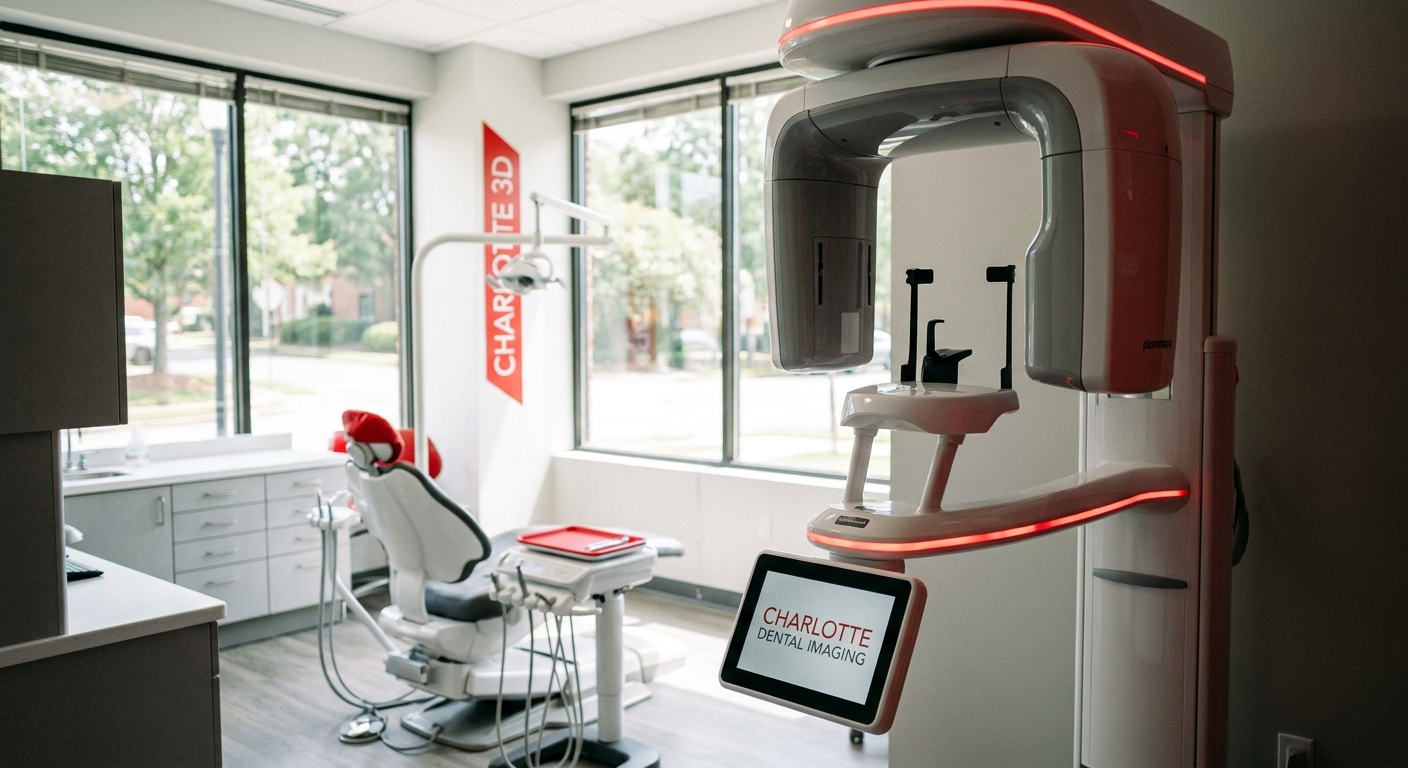
Cone-beam CT is a 3D X-ray, and it can make a walk-in diagnosis faster and more detailed than with traditional methods. A standard two-dimensional dental X-ray flattens everything into a single plane, which can hide certain details. A cone-beam scan shows infection at the tip of a root, the size of a cavity, hidden fractures, and the surrounding bone in far more detail. The Academy of General Dentistry recognizes cone-beam imaging as a valuable tool for complex diagnosis.
That detail can inform decisions in real time. In the Tuesday case above, the 3D scan revealed a vertical root fracture in tooth number 30, a crack running down the root that a flat X-ray can sometimes miss. Seeing it clearly meant the dentist could explain to the patient that the tooth could not be restored and needed to be removed, then plan the extraction and bone graft in the same visit rather than sending the patient home without clarity. The scan also lets the dentist evaluate the bone underneath, which matters if the plan involves replacing the tooth with an implant later.
This is worth underlining because not every walk-in dental setting has cone-beam capability. Charlotte Emergency Dental captures a 3D scan on every emergency patient, right at the start, before the doctor even sits down. That means your diagnosis is built on a more complete picture of what is happening below the gumline. For you, it can mean fewer surprises, a clearer explanation of what is happening, and a treatment plan you can actually see on the screen while the doctor walks you through it, along with a clearer sense of its impact on your overall oral health.
Cost, Financing, and What to Bring When You Walk In
The emergency exam and cone-beam CT scan cost $99 at Charlotte Emergency Dental. That flat price covers the evaluation and 3D imaging that lead to your diagnosis, so you know that number before you set foot in the door. Treatment cost beyond the exam depends entirely on what you need, whether that is an extraction, a root canal, a crown, or an implant to restore your smile, and the dentist provides the treatment options and the cost picture before any work begins. You will not be surprised mid-procedure.
Cost is a concern most people have when walking in, so it helps to know how the practice handles it. Charlotte Emergency Dental is an out-of-network, self-pay office. If you have insurance, you are given the claim forms you need to seek reimbursement directly from your plan. For treatment you would rather spread out, the practice works with several third-party financing companies that break the cost into monthly payments, frequently at zero percent interest, so an unexpected emergency does not have to be paid all at once.
Bring a few things and your visit moves more smoothly. Bring a photo ID, your insurance card if you have one, and a written list of your current medications and any allergies, which matters for antibiotics and numbing. If a tooth was knocked out or a piece broke off, bring it, stored submerged in milk or saline and never water. And if you are anxious about the visit itself, say so at the front desk. The doctors are experienced at working with nervous patients, and anxiolytic medication can be arranged ahead of an appointment when it is needed, though for most people it turns out to be unnecessary.
Frequently Asked Questions
Do I need to call ahead, or can I really just walk in?
You can walk in without calling. The practice sees 10 to 15 same-day emergencies daily, and the entire workflow is built for walk-ins. Calling ahead is optional, but it lets the team prepare for time-sensitive cases like a knocked-out tooth so the chair is ready when you arrive.
How long will I wait if I walk in with a dental emergency?
On weekdays, many patients move from arrival to treatment in about 30 minutes, though individual experiences vary. Weekends can run up to an hour when volume is higher, but wait times typically do not stretch much beyond that.
What if my tooth is knocked out on a Sunday?
Charlotte Emergency Dental is open seven days a week, with extended weekday hours from 9 a.m. to 7 p.m. and adjusted hours on weekends. The reimplantation protocol is followed every day, so a Sunday avulsion is handled the same way as a Tuesday one.
Will I be referred to a specialist, or can the emergency dentist treat me today?
Most emergency cases are treated in-house the same day, including most root canals and extractions. Only select root canals with challenging canal anatomy go to a specialist, and major facial trauma, fractured jaws, or life-threatening swelling are stabilized and referred to a hospital.
How much does an emergency dental visit cost in Charlotte?
The emergency exam and cone-beam CT scan cost $99. Treatment cost beyond that depends on the procedure you need, and the practice offers financing through third-party lenders, often at zero percent interest, so you can spread payments out.
What should I do with a knocked-out tooth before I get to the dentist?
Handle it by the crown, not the root, and do not scrub or rinse it under the tap. Store it submerged in milk or saline, never water, and get to the office within about 60 minutes when possible to improve the chances of successful reimplantation. Individual outcomes vary.
If you are experiencing dental pain right now, or you have a knocked-out, broken, or abscessed tooth, consider seeking prompt care. As a Charlotte emergency dentist built around same-day walk-ins, the team can have you triaged and scanned quickly. Walk into Charlotte Emergency Dental at 4010 Park Rd, Charlotte, NC 28209, or call (704) 525-3939 to let the team know you are on your way so they can have a chair ready when you arrive.
When Dental Pain Can’t Wait, Neither Should You
Dental emergencies don’t follow a schedule, and you shouldn’t have to suffer through a weekend or evening hoping the pain will pass. Charlotte Emergency Dental keeps our doors open seven days a week specifically for moments like yours,whether it’s a knocked-out tooth, severe pain, or an unexpected break that needs immediate attention. Give us a call now and let us help you get comfortable—and smiling—again.
Call Charlotte Emergency Dental