Emergency Root Canal in Charlotte, NC: Same-Day Treatment Without an Appointment
The most common question patients ask when they arrive at Charlotte Emergency Dental in severe tooth pain is not how much a root canal costs or how long it takes. It is whether they will actually be seen today, because most have already been turned away somewhere else or quoted appointment windows three, five, or seven days out. That single question tells you everything about how broken the usual system is for someone in real pain. When the nerve inside a tooth is infected, waiting a week is not an inconvenience. It can carry risks to the rest of your face and body. This page walks you through exactly how same-day emergency root canal care works here, what it costs, and how the process typically unfolds once you walk through the door.
Why Most Charlotte Dental Practices Cannot See You Today for a Root Canal
The reason you keep hearing “next available is Tuesday” comes down to how most Charlotte dental offices are built. A traditional general practice runs a Monday through Thursday schedule packed with cleanings, checkups, and planned procedures booked weeks in advance. Same-day slots, when they exist at all, are few and fill fast. So when your tooth flares up on a Friday afternoon or over a long weekend, there is often no room for you at all. You are left choosing between waiting in pain or heading to an urgent care center or hospital ER that can prescribe antibiotics and pain medication but cannot actually perform a root canal. That gap, the space between “I need help now” and “the earliest we can see you is next week,” is where many people in a dental emergency get stuck.
Charlotte Emergency Dental was built to close that gap. The practice welcomes walk-ins seven days a week with extended weekday hours from 9am to 7pm, which works out to roughly 75 percent more availability than the standard Monday through Thursday office. The team handles about 10 to 15 same-day emergencies every day and sees close to 100 percent of them the same day the patient walks in. That adds up to roughly 50 emergency cases each week, spanning severe toothaches, knocked-out teeth, broken teeth, infections, abscesses, lost or loose crowns, sensitivity, dry sockets, post-extraction pain, and root canals. There is no pre-booking, no phone tag, and no being placed on a callback list while your face swells.
What this means for you is simple. If you are in Charlotte and your tooth is throbbing right now, you do not have to plan around anyone’s calendar. You walk in, get triaged, and can often begin moving toward relief the same day. The seven-day model exists specifically for the person whose emergency does not politely wait until business hours on Monday.
How Same-Day Emergency Root Canal Treatment Works at Charlotte Emergency Dental
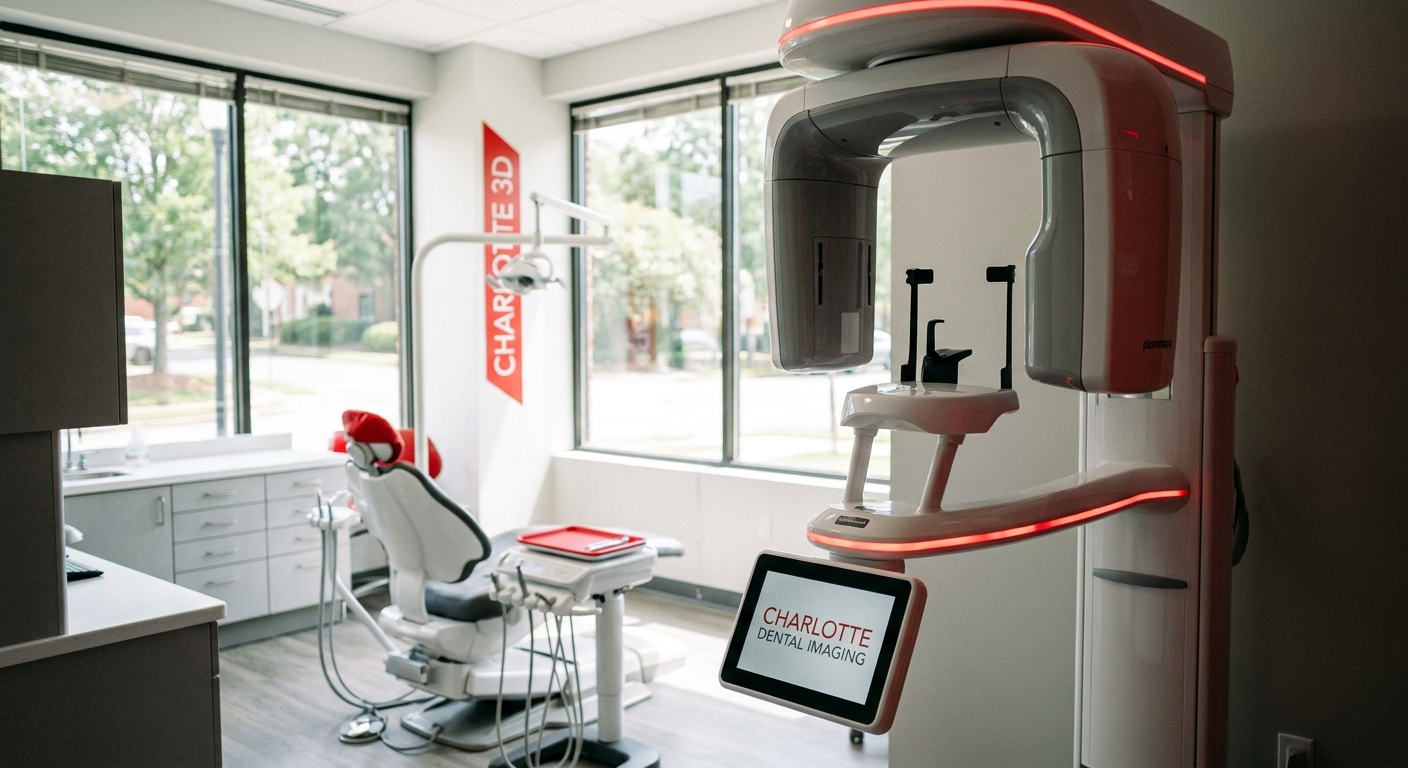
From the moment you step inside, the process is sequenced to address your pain as promptly as possible. The front desk triages you first, asking about the nature and duration of your pain, any swelling, and signs of infection so the most urgent cases move ahead. From there you are brought back for a cone-beam CT (CBCT) scan, a 3D X-ray that shows infection at the root ends, cavities, and the surrounding bone within minutes. You are then moved to an operatory where a dental assistant evaluates you, and the doctor performs an intraoral exam and tooth vitality testing, which includes a percussion test (gently tapping the tooth) and a cold test to see how the nerve responds, along with an infection screening. The doctor then reviews your scan with you on screen, explains what is happening inside the tooth, and lays out your treatment and financing options before anything begins.
The speed of this is a core priority. The average time from walk-in to treatment is about 30 minutes on weekdays, and under an hour on weekends, though this can vary based on your specific situation. Consider a real example from the practice. A patient arrived on a Tuesday at 10:15am in excruciating pain. By 10:30am the CBCT was complete and the diagnosis was confirmed, and by 10:35am the patient was numb and experiencing relief. That is 20 minutes from door to comfort in that particular case, and the full extraction and bone graft were finished by 11:20am. Traditional appointment models often cannot match this speed, because the delay is built into how they schedule.
For an emergency root canal in Charlotte specifically, once the diagnosis is set and you are numb, the doctor accesses the infected pulp, cleans and shapes the canal, and addresses the pressure that has been driving your pain. Many root canals can be completed in-office in a single same-day visit, right alongside the crowns, extractions, implants, bridges, and dentures the practice also offers same-day when possible. The goal is to handle the emergency during your visit when clinically appropriate, not to send you off to wait again.
What CBCT Imaging Reveals That Traditional X-Rays Miss in Root Canal Emergencies
A flat, two-dimensional X-ray is the tool most offices reach for, and for many situations it works fine. But in a root canal emergency, what you cannot see can be clinically significant. A standard 2D image can flatten and overlap structures, potentially hiding an abscess sitting at the very tip of a root or a canal that branches in an unexpected direction. That is exactly the kind of detail that can influence whether your tooth can be addressed today or whether treatment might encounter complications.
Cone-beam CT solves this by capturing your tooth and jaw in three dimensions. The scan reveals infection at the root ends, hidden fractures, cavities, and the true shape of the canal system, along with the density and health of the surrounding bone, which is also why the same scan is used when planning implants. When the doctor pulls that image up with you, the source of your pain is often visible in a way that removes guesswork. If there is an abscess pooling at the root tip, it is right there on the screen. If a canal curves in a way that could complicate treatment, that is visible too, before a single instrument enters the tooth.
For you, this matters in two ways. First, it often enables same-day diagnosis, so treatment can potentially start promptly and with confidence. Second, it lets the doctor tell you honestly and early whether your case is straightforward or whether it falls into the small group that needs a specialist. You are not paying for a diagnosis that gets revised halfway through the procedure. The 3D picture is why a diagnosis can often be confirmed within minutes of your arrival, as it was in the Tuesday case where the scan and diagnosis were done just 15 minutes after the patient walked in.
Which Root Canal Cases Are Treated In-House and Which Require a Specialist Referral
Honesty about limits builds more trust than a promise to handle everything. Many emergency root canals can be completed in-house the same day you arrive, and that covers a large portion of cases that walk through the door. The line gets drawn in a few specific situations, and the CBCT scan is what makes that call clear on your first visit rather than after a failed attempt.
Select cases with exceptionally challenging canal anatomy, such as severely curved or unusually complex canals, may be referred to a specialist who focuses on those situations full-time. This is about giving that particular tooth appropriate specialized care. Separately, a tooth with an unrestorable vertical root fracture, meaning a crack that runs down the root and cannot be repaired, is typically recommended for extraction rather than a root canal, because saving it is not realistically possible. In the rare event of major facial trauma, a fractured mandible, or life-threatening swelling, the appropriate destination is a hospital or emergency room, and the team will tell you that directly.
The practical benefit is clarity. You will know during your first visit whether your tooth can be treated immediately or whether it needs a referral or a different plan. You are not sent home to wonder, and you are not put through a partial procedure only to be handed off. That clarity, delivered the same day, is part of what walk-in care is designed to provide.
Managing Pain and Anxiety During Emergency Root Canal Treatment
Two fears show up together in many root canal patients: the pain of the problem and the fear that the treatment will hurt even more. Before any endodontic work begins, local anesthesia is given with the goal of making you numb. The procedure is designed so you should not feel the drilling or the cleaning inside the tooth. In many cases the moment the anesthesia takes hold brings relief, because the pressure of the infection can ease. That is what happened in the Tuesday walk-in, where the patient went from severe pain to experiencing relief in the minutes after diagnosis.
For some people, though, the anxiety is as intense as the toothache itself. If the thought of sitting in the chair is what has been keeping you from getting care, the practice can prescribe anxiolytic medication to take before your appointment to help you stay calm and tolerate the procedure. This is arranged ahead of time so the medication is working when you need it. Pairing that calming support with local anesthesia addresses both the physical sensation and the emotional concern.
What this looks like in practice is a patient who walks in tense and guarded, gets a clear explanation of each step, feels the tooth go numb, and realizes the part they were most afraid of is manageable. If anxiety is your main barrier, say so at the front desk when you arrive. It changes how your visit is planned, and it is a normal, common request.
Why Delaying a Root Canal Allows Infection to Spread Beyond the Tooth
An infected tooth is not a problem that quietly resolves. The pulp infection at the center of a root canal case is bacterial, and bacteria do not stay politely contained. Clinical guidance from the American Association of Endodontists explains that when infection or an abscess is present and treatment is delayed, bacteria can spread from the tooth into the surrounding bone and soft tissue. What starts as a localized toothache can progress into facial swelling, cellulitis, and in more serious cases conditions like Ludwig’s angina, a dangerous swelling of the floor of the mouth, or a systemic infection that reaches the bloodstream.
The important point that many people miss is this: antibiotics alone cannot address the underlying problem. A course of antibiotics may temporarily calm the swelling, but it cannot sterilize the infected canal system inside the tooth, because there is no blood supply left in that dead tissue to carry the medication there. The infection keeps its home base. That is why urgent care and ER visits so often end with a prescription and a referral back to a dentist. They can manage the symptoms for a moment, but the tooth still needs the root canal to actually remove the source.
This is the real reason timely care matters, not just convenience but medical prudence. Every day an active infection sits untreated is a day it may expand into tissue that is harder to manage. When you address it promptly and clear the canal, you can stop that progression. If you have swelling along with your tooth pain, treat it as a reason to be seen soon. Life-threatening swelling is one of the few situations where the team will send you straight to an emergency room instead.
Cost, Insurance, and Financing for Emergency Root Canal Treatment in Charlotte
Cost uncertainty keeps many people in pain, so here are the real numbers. The emergency exam and X-ray fee at Charlotte Emergency Dental is $99. That covers your evaluation, the CBCT imaging, and the doctor’s diagnosis, so you know what is wrong and what treatment involves before you commit to anything further. The total cost of the root canal itself varies based on which tooth is affected and how complex the canal anatomy turns out to be, since a front tooth with a single canal and a back molar with several are genuinely different procedures. You get those specifics during your visit, not as a vague guess over the phone.
On insurance, the practice is out-of-network with dental carriers. That does not mean your benefits are useless. The team provides insurance claim forms so you can submit directly to your dental plan for reimbursement, and many patients recover a portion of their treatment cost through their benefits this way. It is worth asking your plan how it handles out-of-network restorative care, because the paperwork you need is handled for you here.
For the balance you pay out of pocket, the practice works with third-party financing companies that break treatment into manageable monthly payments, often at 0% interest. That means a root canal you need today does not have to be paid in full today. You can spread it across a plan that fits your budget and still receive care the same afternoon you walk in. The goal is to make sure money is not the reason you sit at home with an infection that may be worsening.
If you are experiencing severe tooth pain, swelling, or abscess symptoms in Charlotte, walk into Charlotte Emergency Dental today for same-day root canal diagnosis and evaluation without an appointment. The practice is open seven days a week with extended weekday hours from 9am to 7pm. Bring your insurance information if you have it, tell the front desk if dental anxiety is a concern so they can plan for it, and expect to move from door to diagnosis promptly. When you need an emergency root canal in Charlotte, the path toward relief starts by walking through the door.
Frequently Asked Questions
Can I walk into Charlotte Emergency Dental for a root canal without calling first?
Yes. The practice accepts walk-ins seven days a week with no appointment required, and handles around 10 to 15 same-day emergencies daily. When you arrive, the front desk triages emergency root canal cases right away by asking about the nature and duration of your pain, any swelling, and infection symptoms, so the most urgent needs can be prioritized.
How long does it take from walking in the door to being evaluated?
The average time from walk-in to treatment is about 30 minutes on weekdays and under an hour on weekends, though this can vary by individual case. This is possible because triage, CBCT imaging, diagnosis, and treatment planning are sequenced back to back without the delays built into traditional appointment scheduling. One recent Tuesday patient arrived at 10:15am in severe pain and was numb and experiencing relief by 10:35am, just 20 minutes later.
Will I need to come back for a second appointment to finish the root canal?
Many root canals can be completed in-office in a single visit the same day you arrive. Some complex cases, or cases that require a permanent crown to fully restore the tooth, may need a follow-up appointment or a referral to a specialist. You will know which applies to you during your first visit.
What if I am too anxious to sit through a root canal procedure?
The practice can prescribe anxiolytic medication to take before your appointment to help ease dental anxiety. On top of that, local anesthesia is given with the goal of ensuring you are numb before any endodontic work starts, so you should not feel drilling or cleaning during the procedure. Let the front desk know anxiety is a concern when you arrive.
Does Charlotte Emergency Dental accept my dental insurance for an emergency root canal in Charlotte?
The practice is out-of-network with insurance carriers, but the team provides insurance claim forms so you can submit to your dental plan for reimbursement. Many patients recover a portion of their treatment cost through their benefits. Ask your plan how it handles out-of-network restorative care.
How much does an emergency root canal cost in Charlotte, NC?
The emergency exam and X-ray fee is $99. Total root canal cost depends on which tooth is affected and how complex the case is, and you receive those specifics during your visit. The practice works with third-party financing companies offering payment plans often at 0% interest, so you can divide the cost into manageable monthly installments.
Don’t Wait on Tooth Pain That Won’t Let Up
When the pain from an infected or damaged tooth becomes unbearable, wondering whether you need to schedule days in advance only adds to the stress. Charlotte Emergency Dental is set up to see patients with severe tooth pain the same day, even without an appointment. If you’re dealing with throbbing pain, swelling, or sensitivity that’s disrupting your day, a quick call can get you the relief you need today.
Call Charlotte Emergency Dental
Individual experiences vary, and treatment timelines depend on each person’s specific condition. Same-day treatment availability depends on individual case complexity and current patient volume. Treatment timelines vary by individual case complexity and diagnostic findings.