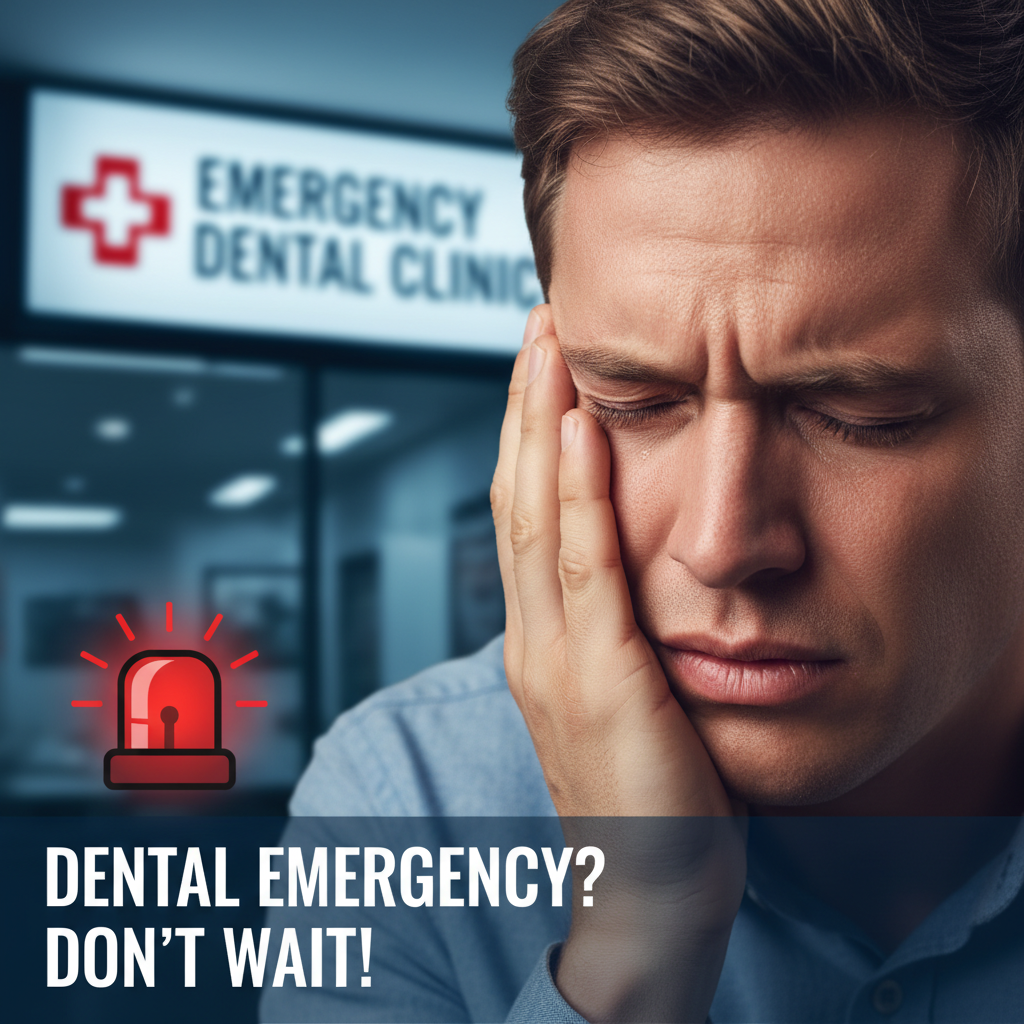
Dental problems that cannot wait are the ones that threaten your health, your ability to keep a tooth, or your ability to breathe, swallow, talk, or sleep. Knowing which issues are true emergencies helps you avoid dangerous delays and also avoid unnecessary panic over minor problems.
Below, you will learn how to tell which dental symptoms mean “call now,” which can wait a short time, and what you can safely monitor at home.
You will also find links to helpful guides like what is considered a dental emergency and urgent vs non urgent dental issues if you want to read further.
What makes a dental problem an emergency
A dental problem usually counts as an emergency when it meets at least one of these conditions [1]:
- Severe or rapidly worsening pain
- Uncontrolled bleeding
- Swelling in the gums, face, or jaw
- Signs of infection such as fever, pus, or a bad taste
- Trauma that breaks, knocks out, or moves teeth, or injures the jaw
In simple terms, you should treat something as an emergency if:
- Waiting could mean losing a tooth
- Infection might spread to your jaw, neck, or bloodstream
- Your breathing, swallowing, or ability to open your mouth is affected
If you are unsure, read through the sections below and also check how to decide if you need urgent dental care.
Severe toothache that keeps you from normal life
Tooth pain that is mild and comes and goes can often wait a short time. A toothache that is intense, constant, or wakes you from sleep is very different.
Unbearable tooth pain that makes it hard to eat, talk, or sleep is one of the most common dental problems that cannot wait. It is often a sign of:
- Deep decay that has reached the nerve
- A serious infection or abscess
- An inflamed or dying tooth nerve, known as pulpitis
Severe or persistent toothache can allow infection to spread to the jawbone or even the bloodstream if you ignore it, and that can be life threatening [2].
If you are unsure whether your toothache counts as an emergency, these guides can help you think it through:
- how to know if tooth pain is emergency
- how serious is tooth pain
- how long can you wait with tooth pain
What you can do right away
While you wait to be seen:
- Rinse gently with warm water
- Floss around the painful tooth to remove trapped food
- Apply a cold compress on the outside of your cheek
- Use over the counter pain relievers like acetaminophen or ibuprofen, if you can take them safely
These steps may ease the pain but they do not replace treatment. Experts stress that temporary remedies like salt water rinses, cold compresses, and clove oil only offer short term relief and you still need prompt dental care to treat the cause [3].
Swelling in your gums, face, or jaw
Swelling is one of the clearest signs that your dental problem cannot wait. It usually means there is an infection under the tooth or in the gum that is spreading into nearby tissues.
You should treat swelling as urgent if:
- Your cheek, jaw, or face looks puffy
- You feel warmth, throbbing, or a tight sensation
- There is a bad taste in your mouth or visible pus
- You have fever, feel generally unwell, or have trouble opening your mouth
Swelling of the gums, face, or jaw is considered a critical dental emergency because an infection in deeper tissues can spread quickly and become life threatening [4]. Facial swelling can indicate an abscess that might spread to the neck or airway, cause cellulitis, or even lead to sepsis if not treated right away [5].
If swelling is paired with fever, difficulty breathing, or difficulty swallowing, go to an emergency room immediately, not just a dental office [6].
To learn more about how serious gum or facial swelling can be, see when gum swelling is an emergency.
Dental abscess or infection
A dental abscess is a pocket of pus caused by infection around the root of a tooth or in the gums. It often shows up as:
- A painful, swollen bump near a tooth
- Throbbing pain that may radiate to your ear, jaw, or neck
- Swelling in your face or jaw
- Fever or feeling ill
- A foul taste or odor in your mouth
An abscess is one of the classic dental problems that cannot wait. Dental abscesses need urgent care because the infection can spread to other parts of your body, including your jaw, neck, or brain, and may cause sepsis if untreated [7].
Doctors note that spreading infections like cellulitis, which show painful swelling, fever, and enlarged lymph nodes, may require hospital care, intravenous antibiotics, and sometimes surgery to prevent airway compromise and other serious complications [8].
You can rinse with a mild salt water solution and apply an ice pack to ease discomfort for a short time, but you should not try to drain the abscess yourself [9].
Knocked out or very loose permanent tooth
A knocked out permanent tooth, called an avulsed tooth, is one of the most time sensitive dental emergencies. You have a small window, usually 30 to 60 minutes, to have the best chance of saving it [10].
This problem cannot wait because:
- The cells on the root surface die quickly once the tooth is out of the mouth
- Quick reimplantation gives you the best chance of keeping your natural tooth
- Delay might mean you need more complex work later, such as implants or bridges
Experts describe avulsion as a true emergency that needs immediate reimplantation at the scene whenever possible, followed by urgent dental care for splinting and antibiotics [8].
What to do with a knocked out tooth
- Find the tooth and pick it up by the crown, not the root.
- Rinse it gently with water if it is dirty. Do not scrub or remove attached tissue.
- If you can, gently place it back into the socket and hold it there by biting down softly.
- If you cannot reinsert it, place it in a container of milk or a salt water solution, or tuck it between your cheek and gums to keep it moist [9].
- See a dentist or emergency provider immediately, ideally within one hour [11].
A tooth that has become very loose after an accident is also urgent. Rapid treatment improves the chances that your dentist can stabilize and save it [12]. For more detail, you can review how to identify dental trauma severity and how to assess dental injury.
Uncontrolled bleeding in the mouth
A small amount of bleeding after brushing or flossing is not normal but it usually is not an emergency. On the other hand, heavy or persistent bleeding in your mouth should never be ignored.
Uncontrolled bleeding after trauma, dental surgery, or tooth extraction that lasts more than an hour, even with pressure, calls for immediate attention [13].
You can:
- Fold clean gauze and bite down firmly on the area
- Stay upright and avoid rinsing, spitting, drinking through a straw, or smoking
If bleeding continues or worsens, contact your dentist or seek urgent care. Uncontrolled bleeding is one of the standard signs that a dental issue needs immediate help [1].
For ongoing gum bleeding that is not linked to an injury, see when bleeding gums are serious.
Deep cracks, large breaks, or lost fillings and crowns
Not every chip or crack is a middle of the night emergency, but some clearly are dental problems that cannot wait.
You should seek urgent dental care if:
- A tooth is badly broken with sharp edges and visible inner layers
- You feel a crack when you bite, followed by sudden pain or sensitivity
- A large piece of tooth has broken off and you are in pain
- You lose a filling or crown and the tooth is sensitive or hurting
Sudden sharp pain or new sensitivity when biting, or to hot, cold, or sweets, can be a sign of a cracked tooth or deep cavity that needs prompt evaluation to prevent more damage [14]. Broken, chipped, or cracked teeth can quickly become painful, sensitive, and prone to decay or infection and dentists recommend timely treatment to protect the tooth [15].
Even small chips create entry points for bacteria, weaken the tooth structure, and can lead to more serious problems if you delay care [16]. Waiting can make treatment up to five times more expensive and might turn a simple filling into a root canal, crown, or even surgery [6].
If you are not sure how serious your tooth damage is, these resources can help:
- is a cracked tooth a dental emergency
- is a chipped tooth an emergency
- tooth damage emergency vs minor
Persistent gum problems and bite changes
Some gum and bite changes develop quietly and can be easy to ignore. They may not feel like emergencies, but they are problems that should not wait very long.
You should contact your dentist promptly if you notice:
- Gums that bleed regularly when you brush or floss
- Swollen, tender, or receding gums
- A new bad taste or persistent bad breath
- Teeth that suddenly feel looser than before
- A change in how your teeth fit together when you bite or chew
Bleeding gums are never normal and can signal gum disease or infection. Left untreated, this can spread and eventually cause bone loss and tooth loss [17]. Changes in your bite can also point to infection, trauma, or advanced gum disease and they should be checked quickly to prevent major structural problems [4].
Conditions like acute periodontal abscesses, which cause throbbing pain, swelling, and loose teeth, need dental referral within 24 hours for drainage and cleaning to avoid progression to more serious infection [8].
To understand when a gum issue crosses the line into urgent territory, take a look at when bleeding gums are serious and what dental issues need immediate care.
Tooth sensitivity that suddenly worsens
Mild sensitivity to cold air or very cold drinks is common and often related to exposed root surfaces or wear. That kind of sensitivity can usually wait for a regular appointment.
However, you should not ignore sensitivity that is:
- New and getting worse over days
- Triggered by hot foods and drinks
- Paired with lingering pain after the trigger is gone
- Combined with swelling, visible damage, or a cavity you can see
Persistent sensitivity to hot or cold can signal nerve inflammation, enamel damage, decay, infection, or cracks in the tooth [16]. If you let this go, the nerve can die, the tooth can crack, and you may end up needing a root canal or extraction [18].
When sensitivity is intense or lingers, treat it as a sign that your tooth needs timely evaluation, not a problem to ignore.
When you should go to emergency care instead of the dentist
Sometimes dental problems become medical emergencies. You should go to an emergency room or call emergency services right away if you have:
- Facial or neck swelling plus fever or feeling very unwell
- Trouble breathing or swallowing
- Difficulty opening your mouth combined with swelling and pain
- Trauma that may involve broken facial bones or heavy bleeding
Serious infections like spreading cellulitis or severe pericoronitis, an infection around a partially erupted tooth, can affect your airway and may require hospital treatment, intravenous antibiotics, and specialist care [19].
If an emergency happens outside normal office hours and you cannot reach your dentist, you can call their emergency number, visit urgent care, or go to an emergency room. Providers there can help with pain and swelling, although they may not be able to complete final dental restorations [1].
For more on this decision, read when to go to emergency dentist and how to decide if you need urgent dental care.
Quick reference: dental emergency warning signs
Use this brief list as a mental checklist when something feels off. If your answer is “yes” to any of these, do not wait to seek care:
- Is the pain severe, constant, or waking you from sleep?
- Is there noticeable swelling in your gums, face, or jaw?
- Do you have fever, feel sick, or notice pus or a bad taste?
- Is a tooth knocked out, very loose, or badly broken?
- Is there heavy or ongoing bleeding that will not stop?
- Has your bite suddenly changed or do your teeth feel loose?
- Is a minor issue, like a chip or sensitivity, getting worse quickly?
If you are still unsure, you can cross check your symptoms with dental emergency warning signs, what counts as dental emergency symptoms, and when dental pain becomes urgent.
When something in your mouth suddenly feels very wrong, it is almost always safer to call than to wait.
Taking the next step with confidence
You do not need to diagnose yourself perfectly. Your job is simply to notice when something is severe, sudden, or steadily getting worse. That is usually enough to justify a same day call.
Here is a simple way to move forward:
- Check your symptoms against the sections above.
- If you suspect a serious issue, contact a dentist and mention the specific signs you notice.
- If breathing, swallowing, or facial swelling is involved, go to emergency care right away.
If you want to learn more about how to separate urgent concerns from minor ones, explore urgent vs non urgent dental issues and what dental issues need immediate care.
Acting quickly often means less pain, simpler treatment, and a much better chance of saving your teeth.
References
- (Cleveland Clinic)
- (Star Dental Institute, American Academy of Family Physicians)
- (Cleveland Clinic, Tompkins Dental)
- (Warwick Dental)
- (Star Dental Institute, Amazing Family Dental)
- (Amazing Family Dental)
- (Cleveland Clinic, Amazing Family Dental)
- (American Academy of Family Physicians)
- (Cleveland Clinic, Edgerly Dentistry)
- (Cent Report Smiles, Amazing Family Dental)
- (Cleveland Clinic, Golden State Dentistry)
- (Star Dental Institute)
- (Cent Report Smiles, Edgerly Dentistry)
- (Cent Report Smiles)
- (Star Dental Institute, Golden State Dentistry)
- (Warwick Dental, Tompkins Dental)
- (Warwick Dental, Star Dental Institute)
- (Tompkins Dental)
- (American Academy of Family Physicians, Amazing Family Dental)