Dental problems have a way of showing up at the worst possible time. You might find yourself wondering what counts as dental emergency symptoms and what can safely wait for a regular appointment. Knowing the difference can save you pain, stress, and, in some cases, protect your overall health.
This guide walks you through the most common dental emergency symptoms, how urgent they really are, and what to do next so you can act with confidence instead of guessing.
What a dental emergency actually is
When you hear “dental emergency,” you might think of dramatic injuries. In reality, many emergencies start with symptoms that seem mild at first.
According to the American Dental Association, a dental emergency is any problem that needs immediate treatment to stop bleeding, control a serious infection, or relieve severe pain, and that could otherwise lead to serious health, functional, or cosmetic problems if you delay care [1].
In plain language, it is an emergency if:
- The pain or bleeding is severe,
- There are signs of spreading infection, or
- Waiting is likely to cause permanent damage.
For a broader overview of how dentists categorize problems, you can also review what is considered a dental emergency in general at what is considered a dental emergency.
Red flag symptoms that usually mean “go now”
Certain symptoms are strong warning signs that you need urgent or immediate care. If you ever feel unsure, err on the side of caution and contact a dentist or medical professional.
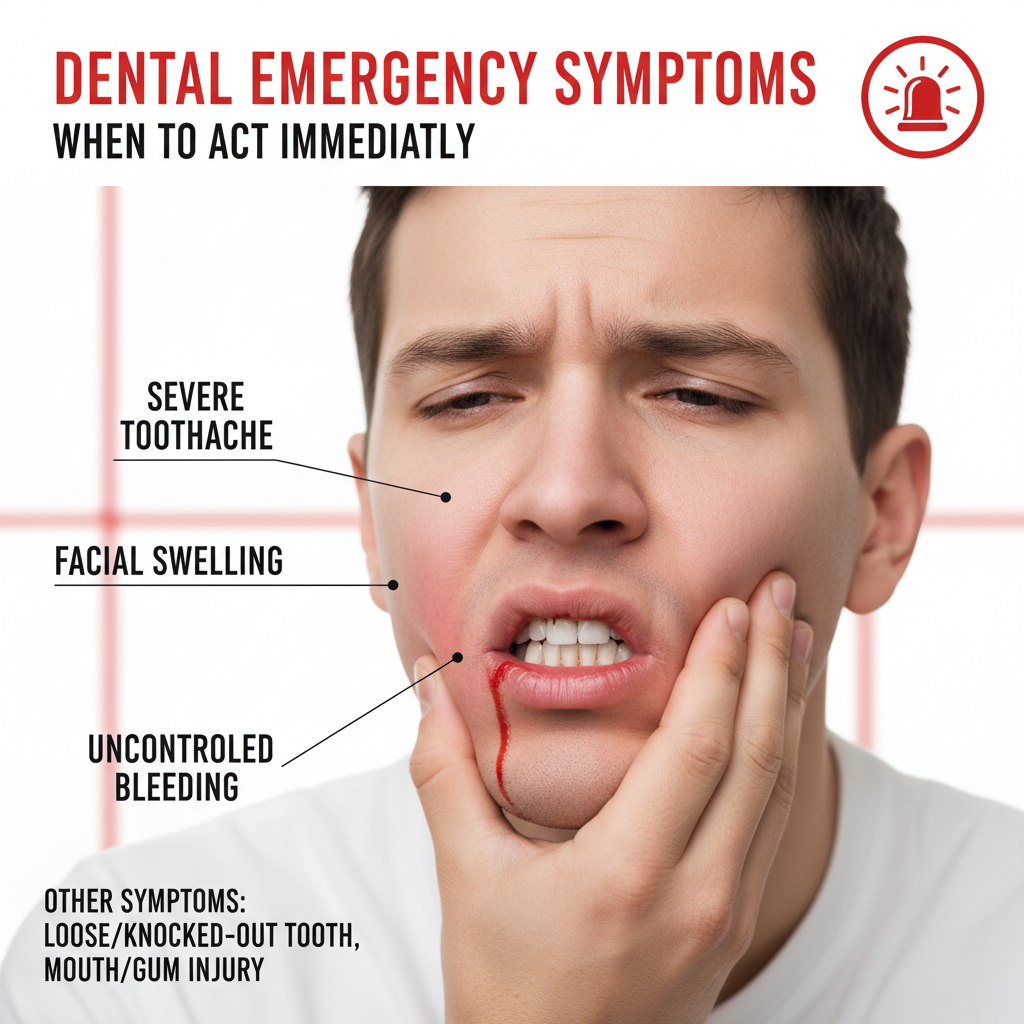
1. Severe toothache that will not ease up
Tooth pain that is mild and comes and goes is often not an emergency. A severe toothache that throbs, keeps you from sleeping, or does not improve with over the counter medication is different.
Persistent, intense tooth pain often points to:
- Deep decay that has reached the nerve of your tooth
- An abscess or infection
- A cracked or fractured tooth
The Cleveland Clinic notes that a severe toothache that does not get better with pain relievers is considered a dental emergency [2]. Similar guidance from dental practices stresses that unbearable pain needs immediate evaluation to prevent complications like abscesses and tooth loss [3].
If you are dealing with this, read more about how to know if tooth pain is emergency and how serious is tooth pain.
You should seek same day or emergency care if:
- Pain is sharp, throbbing, or constant
- Pain wakes you up at night
- Over the counter medication barely helps or does not help at all
- The tooth also feels high, loose, or very sensitive to hot and cold
If you are wondering how long you can safely wait, our guide on how long can you wait with tooth pain explains timelines in more detail.
2. Swelling in your face, jaw, or gums
Swelling is your body’s way of telling you something is wrong. Localized, mild gum puffiness can often wait. Noticeable swelling in your cheek, jawline, or under your tongue is much more serious and can point to infection.
An infectious dental emergency often starts with untreated decay, progresses to inflammation in the tooth’s nerve (pulpitis), then to pulp death, gum infection, and eventually an abscess. If not treated, these infections can spread to deeper spaces in your head and neck and even threaten your airway [1].
According to Machesney Dental Studio, swelling in the gums, jaw, or face, especially with pain, fever, or a foul taste, can indicate an abscess that needs urgent treatment to prevent serious or life threatening complications [4].
Go to an emergency dentist or emergency room right away if:
- Swelling is spreading across your face or toward your eye or neck
- You have difficulty swallowing or breathing
- You have a fever, feel generally unwell, or notice a bad taste from pus
You can learn more about specific situations in when gum swelling is an emergency and dental problems that cannot wait.
3. Trouble breathing or swallowing
If a dental problem is making it hard to breathe, talk, or swallow, it is not just a dental issue anymore. It is a medical emergency.
Severe dental infections can cause rapid swelling that narrows your airway. Emergency physician Dr. Troy Madsen notes that if dental swelling starts to affect your breathing, that is the point when you must go to the emergency room immediately [5].
Call 911 or go to the nearest ER if:
- You feel like your throat is closing
- You cannot swallow your own saliva
- You are short of breath or wheezing
Do not wait for a dental office to open in this situation. Medical teams can protect your airway and start antibiotics, then coordinate with a dentist or oral surgeon.
4. Bleeding that will not stop
Some minor bleeding after brushing, flossing, or dental work is common. It becomes an emergency when it is heavy or does not slow down.
The Cleveland Clinic defines a dental emergency in part as bleeding that does not stop or improve with pressure or medication [2]. Machesney Dental Studio also highlights excessive or uncontrollable bleeding after injury or extraction as a sign that you need urgent help [4].
Seek immediate care if:
- Bleeding continues heavily for more than 15 to 20 minutes despite firm pressure
- Blood is pooling in your mouth
- You are lightheaded or feel faint
Post extraction bleeding that goes on for 8 to 12 hours, especially if you take blood thinners or have a bleeding disorder, needs prompt evaluation and treatment [1].
If bleeding is mild but frequent when you brush or floss, see more guidance in when bleeding gums are serious.
5. Tooth knocked out or badly displaced
A permanent tooth that has been knocked out (avulsed) is one of the clearest dental emergencies. Time is critical.
Both Machesney Dental Studio and Golden State Dentistry emphasize that a knocked out adult tooth must be seen immediately to maximize the chance of saving it [3]. Ideally, you reach a dentist within 30 minutes.
If your tooth is knocked out:
- Handle it only by the crown, the white chewing part.
- Gently rinse off dirt with milk or saline if available. Do not scrub or remove tissue.
- If possible, place it back into the socket and gently bite down on gauze.
- If you cannot reinsert it, keep it moist in milk, saline, or your cheek.
- Go to an emergency dentist or ER immediately.
A tooth that is pushed out of position but not fully out, called a luxation or extrusion, also needs urgent care. Abnormal mobility, displacement, visible fractures, and missing teeth after trauma are all classed as traumatic dental emergencies that require prompt evaluation to prevent infection and long term damage [1].
For help judging how severe an injury is, see how to assess dental injury and how to identify dental trauma severity.
6. Large cracks or fractures in a tooth
Not every chip is an emergency, but large fractures are.
A small chip that does not hurt can usually wait a short time. Chips on front teeth that are only cosmetic, with no pain, are less urgent. However, chips or fractures on chewing surfaces that cause pain when you bite should be treated as emergency symptoms [6].
A large break that exposes inner tooth layers or the root makes the tooth very sensitive and prone to infection. West Linn Dental notes that these larger fractures need immediate dental attention to protect the tooth and prevent complications [7].
You can read more detailed guidance in:
- is a cracked tooth a dental emergency
- is a chipped tooth an emergency
- tooth damage emergency vs minor
Seek urgent care if:
- You are in significant pain
- A large portion of the tooth is missing
- You can see a pink or red spot in the tooth (exposed nerve)
- The tooth is loose, moving, or feels “different” when you bite
7. Signs of an abscess or spreading infection
An abscess is a pocket of pus caused by infection. It usually appears near the root of a tooth or in the gums and can be very painful.
Common symptoms include:
- Severe, throbbing toothache
- Swelling in your gums or face
- A pimple like bump on the gum that may drain pus
- Fever, tender lymph nodes, bad taste or odor in your mouth
West Linn Dental and Golden State Dentistry both describe an abscessed tooth as a serious dental emergency because the infection can spread to the jaw, surrounding tissues, and even other parts of the body if untreated [8].
Infectious dental emergencies typically progress from decay to pulpitis, pulp death, gum infection, and abscess, then potentially to deep space infections and airway compromise if you continue to wait [1].
You should seek urgent dental or medical care if:
- You suspect an abscess and have moderate to severe pain
- Swelling is present, especially with fever or feeling ill
- Pain is not controlled with over the counter medication
If swelling spreads to your neck or causes difficulty breathing, go straight to the ER, as advised by University of Utah Health [5].
8. Soft tissue injuries with heavy bleeding
Cuts and injuries to your lips, tongue, cheeks, or gums can sometimes look worse than they are. The mouth has a rich blood supply, so even small wounds can bleed a lot.
You need emergency care when:
- Bleeding is heavy or uncontrollable
- The cut is deep or gaping
- Tissue is torn or partially detached
The Cleveland Clinic classifies severe soft tissue injuries with uncontrolled bleeding as dental emergencies that require immediate attention [2].
If bleeding slows with pressure and the wound is small, you might be able to wait for a dental visit. When in doubt, take photos and call your dentist for guidance.
Symptoms that feel scary but are usually non urgent
Now that you have a sense of what counts as dental emergency symptoms, it helps to know what often looks alarming but usually can wait for a scheduled appointment. These are still important to treat, just not always the same day.
Mild toothache or sensitivity
Not every toothache is an emergency. Dr. Troy Madsen points out that a toothache alone, if the pain is manageable with over the counter medication and there are no other serious symptoms, usually does not require an ER visit [5].
You can often schedule a regular appointment if:
- Pain is mild to moderate
- Pain comes and goes instead of being constant
- Pain improves with ibuprofen or acetaminophen
- There is no swelling, fever, or trouble swallowing
However, tooth pain rarely resolves without treatment, and ignoring it can lead to more serious problems and higher costs down the road [9]. It helps to understand when dental pain becomes urgent and how to decide if you need urgent dental care.
Occasional bleeding gums when brushing or flossing
Seeing a bit of pink in the sink is common, especially if you have not flossed regularly. That said, frequent bleeding can signal gum disease.
Nyomis Oral Surgery notes that bleeding gums during brushing or flossing can indicate plaque buildup under the gumline, which may lead to tooth decay or periodontal disease affecting bone and tissue if you do not address it [6].
You typically do not need same day emergency care if:
- Bleeding is light and stops on its own
- You are not in pain
- There is no significant swelling
You should, however, schedule a dental exam soon. Our guide on when bleeding gums are serious can help you judge urgency.
Small chips or worn edges
Cosmetic chips that do not hurt and do not expose inner tooth layers can usually wait. West Linn Dental notes that small chips or minor breaks typically are not emergencies unless they expose deeper layers or cause pain [7].
It is still smart to have them checked, because rough edges can cut your tongue and cracks can grow over time.
To compare different types of tooth damage, see tooth damage emergency vs minor.
ER, urgent care, or dentist: where should you go?
Even when you know what counts as dental emergency symptoms, choosing the right place for help can be confusing.
Here is a quick guide:
Go to the ER or call 911 if:
You have trouble breathing or swallowing, rapidly spreading swelling, heavy uncontrolled bleeding, or facial trauma involving possible broken bones.
The Cleveland Clinic includes broken facial bones in its list of emergencies that require hospital level care [2]. University of Utah Health emphasizes that ERs can provide antibiotics and pain relief, but they do not perform dental treatments like extractions [5].
Consider urgent care if:
- You have severe dental pain after hours
- There may be an infection and you need antibiotics quickly
- You cannot reach a dentist the same day
Urgent care can offer similar help to an ER for pain and infection control, but you will still need to see a dentist for definitive treatment [5].
Head to an emergency dentist if:
- Pain is severe but you are breathing and swallowing normally
- A tooth is knocked out, cracked, or badly chipped
- A filling or crown has fallen out and the tooth is painful
- You suspect an abscess but swelling is still localized
Losing a filling or crown is not always dramatic, but it does count as an urgent symptom when it leaves your tooth painful or exposed, because bacteria can quickly cause more damage [10].
To get a clearer feel for different settings and timelines, explore when to go to emergency dentist and urgent vs non urgent dental issues.
Practical steps while you seek help
Once you recognize that your symptoms might be urgent, small actions at home can make you more comfortable and sometimes protect your tooth while you arrange care.
- For pain: Take over the counter pain relievers such as ibuprofen or acetaminophen if you can use them safely. Avoid placing aspirin directly on the tooth or gum since that can burn the tissue.
- For swelling: Use a cold compress on the outside of your face for 10 to 20 minutes at a time. Do not apply heat to a suspected infection.
- For knocked out or broken teeth: Save any fragments, keep the tooth or pieces moist, and avoid touching the root.
- For bleeding: Rinse gently once, then place clean gauze or a damp tea bag over the area and bite down with firm pressure.
- For suspected abscess: Do not attempt to drain it yourself. Rinse gently with warm salt water, one half teaspoon of salt in a glass of warm water, to ease discomfort.
If you are ever unsure how urgent your situation is, look over dental emergency warning signs, signs you need emergency dental care, and what dental issues need immediate care while you contact a dentist.
Putting it all together: when to act fast
To quickly recap what counts as dental emergency symptoms that need immediate care, watch for:
- Severe, unrelenting toothache that does not improve with medication
- Noticeable swelling in your face, jaw, or under the tongue, especially with fever
- Trouble breathing or swallowing
- Heavy or prolonged bleeding that will not slow with pressure
- Knocked out, severely displaced, or badly fractured teeth
- Signs of an abscess, such as throbbing pain, swelling, pus, and feeling unwell
- Deep cuts or tears in your mouth with uncontrolled bleeding
Problems that often can wait a short time include mild to moderate pain, small chips without pain, and light bleeding gums. These still deserve attention, since untreated tooth decay, gum disease, and infection can lead to serious health issues like cardiovascular disease, diabetes complications, respiratory infections, and pregnancy complications over time [9].
If something feels off, trust your instincts. Use the resources on when dental pain becomes urgent and how to decide if you need urgent dental care as a starting point, then reach out to a professional. A short phone call today can prevent a much bigger problem tomorrow.
References
- (NCBI Bookshelf)
- (Cleveland Clinic)
- (Machesney Dental Studio; Golden State Dentistry)
- (Machesney Dental Studio)
- (University of Utah Health)
- (Nyomis Oral Surgery)
- (West Linn Dental)
- (West Linn Dental; Golden State Dentistry)
- (Penn Dental Medicine)
- (Nyomis Oral Surgery; Golden State Dentistry; Cleveland Clinic)