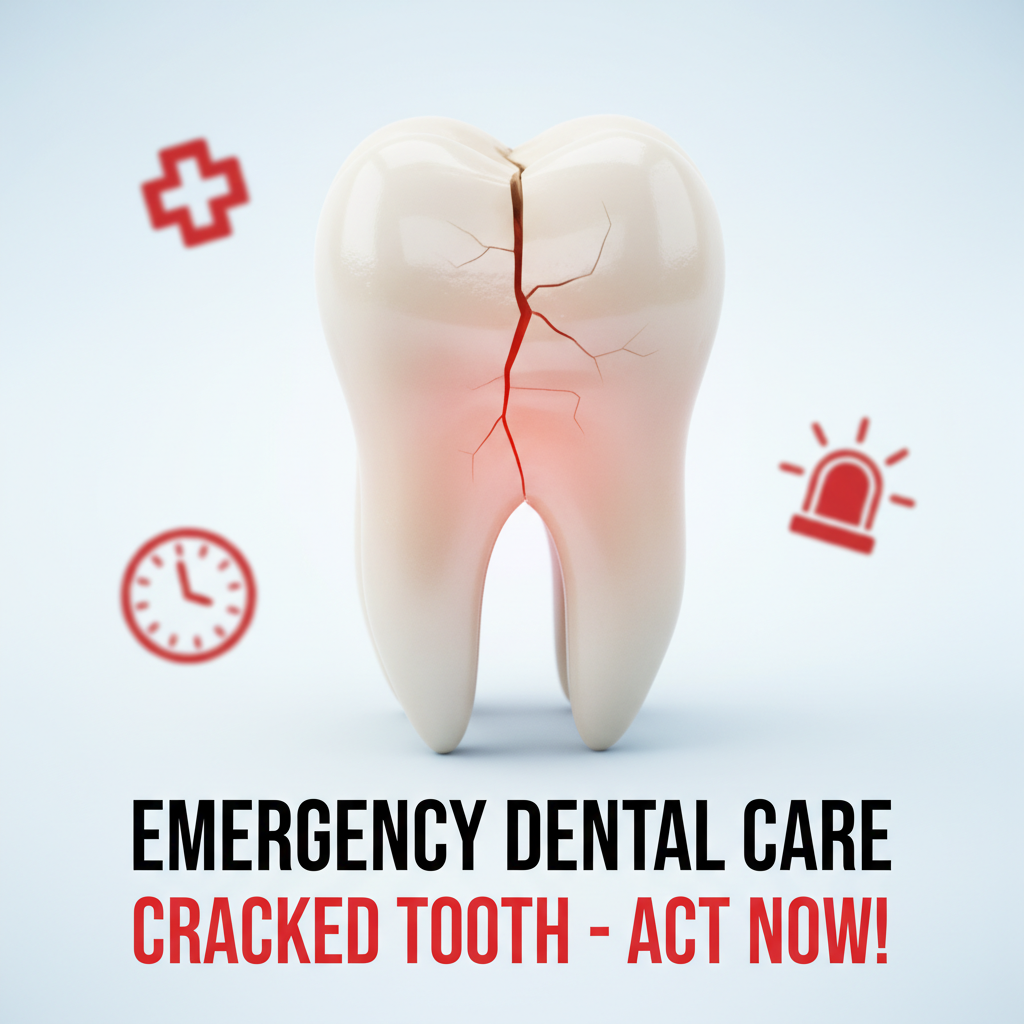
A cracked tooth can feel alarming, especially if it happens suddenly while you are eating or chewing on something hard. If you are wondering, “is a cracked tooth a dental emergency,” you are not alone. The answer depends on your symptoms, the type of crack, and how quickly you can see a dentist.
This guide walks you through how to tell if you need same day care or if your situation can safely wait, so you are not left guessing in pain at home.
What counts as a dental emergency?
Before you focus on your cracked tooth, it helps to know what is considered a dental emergency in general. A dental emergency is any problem that needs immediate professional attention to stop severe pain, control bleeding, prevent infection, or save a tooth. That might mean calling right away or arranging a visit within 24 hours, depending on the issue.
Common examples of true emergencies include:
- Severe or worsening tooth pain that does not improve with medication
- A tooth that is knocked out or very loose after an injury
- Heavy bleeding from the mouth that does not slow down
- Facial swelling, especially if it affects your eye, jaw, or breathing
- Signs of serious infection, such as fever with a swollen, painful tooth
If you want a broader overview of which issues need fast treatment and which can wait, you can read more about what is considered a dental emergency and urgent vs non urgent dental issues.
When a cracked tooth is an emergency
A cracked or broken tooth often is a dental emergency, especially when pain or visible damage is involved. Many dentists, including MKR Dental, consider cracked teeth high priority because they can lead to pain, sensitivity, and serious infections if not treated quickly [1].
You should treat a cracked tooth as an emergency and seek immediate or same day care if you notice any of the following:
- Sudden, sharp pain when chewing or biting
- Sensitivity to hot, cold, or sweet foods that lingers
- Intermittent but intense pain that comes and goes
- Swelling or puffiness around the tooth or in your face
- A piece of the tooth has broken off, leaving a jagged edge
- The crack is deep or runs toward the gumline
- The tooth feels loose, or part of it is displaced
When biting down on something hard, such as ice or candy, a crack can open suddenly and allow bacteria into the inner layers of the tooth. This is a classic sign that you should not wait to call your dentist [2]. If the pain is strong, gets worse, or your tooth was partially or fully knocked out, it is almost always considered an emergency that needs same day attention [3].
If you are not sure how serious your symptoms are, resources like how to know if tooth pain is emergency and what counts as dental emergency symptoms can also help you decide.
When a cracked tooth can wait a short time
Not every crack needs a middle of the night trip to an emergency dentist. Some minor cracks or chips are urgent but not critical. In those cases, you still should see a dentist promptly, just not necessarily within hours.
A cracked tooth may be non urgent if:
- You only see a small chip or craze line in the enamel
- You have little or no pain
- There is no bleeding
- The tooth is stable and does not feel loose
- You can chew carefully on the opposite side without discomfort
Oak Tree Family Dental notes that minor chips and small cracks that do not cause severe symptoms usually need prompt, planned dental care, not emergency care that same day [3]. Media Center Dental also explains that small cracks or chips often can wait, as long as you avoid hard foods and use over the counter medication for any mild discomfort [4].
Even if your cracked tooth feels minor, it is still important to book a visit soon. Small cracks do not heal on their own, and they can deepen over time, turning a simple fix into a more complex one [5]. To understand this difference in more detail, you can review tooth damage emergency vs minor and how to assess dental injury.
Symptoms that mean you should not wait
Because it can be hard to judge damage in the mirror, focus on what you feel. Certain symptoms are red flags that your cracked tooth is an emergency and you should not delay care.
Pay close attention if you notice:
- Pain that is sharp, throbbing, or keeps you awake at night
- Pain when biting down or releasing pressure
- Swelling around the tooth, jaw, or face
- A bad taste in your mouth, or pus near the tooth
- Fever, feeling unwell, or fatigue paired with tooth pain
- Bleeding from the area that does not stop
Cracked teeth often cause pain when chewing and can quickly become infected if bacteria enter through the crack, which is why prompt treatment is so important [6]. Empire Dental Specialty notes that pain from a cracked tooth can start off mild and then progress to sharp, persistent discomfort if you wait, which signals that the damage is getting worse [7].
For more help interpreting pain signals, you can read how serious is tooth pain, when dental pain becomes urgent, and how long can you wait with tooth pain.
Why you should not ignore a cracked tooth
Even if your cracked tooth does not hurt much at first, it is risky to ignore it. Many dental practices warn that cracked and broken teeth tend to worsen when left alone, not improve.
Here is what can happen if you delay treatment:
- The crack can deepen and reach the inner pulp of the tooth
- Bacteria can enter and cause infection or an abscess
- Pain can progress from mild to severe, constant discomfort
- The tooth can become loose or break apart further
- You may eventually lose the tooth and need an implant or bridge
MKR Dental emphasizes that untreated cracked teeth can lead to deeper cracks, infection, unbearable pain, and ultimately tooth loss, which is why they treat them as dental emergencies [1]. OKC Smiles shares a similar warning, noting that minor chips and cracks can evolve into problems that require crowns, root canals, or even implants if you wait too long [6].
Cleveland Clinic also points out that a badly cracked tooth can allow bacteria to seep into the tooth pulp and cause an abscess, which can spread to your jawbone and facial tissues if untreated [5]. In short, serious dental issues, including cracked teeth, do not resolve on their own and must be addressed promptly to avoid complications [2].
If you are unsure about waiting, guides like dental problems that cannot wait and signs you need emergency dental care can support your decision.
Common causes of cracked teeth
Understanding how cracks happen can help you decide how urgent your situation may be and how to prevent new problems in the future. Cracked teeth often result from:
- Biting on hard foods, ice, hard candy, or unpopped popcorn kernels
- Old, large fillings that weaken the surrounding tooth structure
- Grinding or clenching your teeth, especially at night
- Sudden trauma, such as a fall, sports injury, or car accident
- Temperature extremes, such as eating something very hot then drinking ice water
If your tooth cracked after a strong hit to your face or jaw, treat that as potentially serious dental trauma even if pain is mild. Resources like how to identify dental trauma severity and how to assess dental injury can help you understand when to act quickly.
Types of cracks and what they might mean
Not all cracks are equal. Your dentist will evaluate the type and location of the crack to decide how urgent it is and what treatment you need. While you cannot diagnose yourself, it may help to know the general categories:
- Craze lines are tiny, shallow lines in the outer enamel. They are common in adults and usually do not need treatment if they are painless.
- Fractured cusp involves a piece of tooth that breaks off around a filling. It may or may not cause pain, but it usually needs a restoration.
- Cracked tooth extends from the chewing surface toward the root. This often causes pain with chewing and can be serious if the crack reaches the pulp.
- Split tooth means the tooth has separated into distinct segments. This typically requires more complex treatment and is an emergency.
- Vertical root fracture starts in the root and may not show clear symptoms until infection develops.
Cleveland Clinic notes that some hairline cracks that do not cause pain or infection may not need treatment, but deeper or symptomatic cracks must be evaluated promptly because a cracked tooth cannot heal by itself [5].
If you are unsure which type you may have, err on the side of caution and call your dentist for guidance. You can also look at how to decide if you need urgent dental care to support your choice.
What to do right after you crack a tooth
What you do in the first few minutes and hours after cracking a tooth can reduce pain and protect the tooth until you see a dentist. Try to stay calm and take these simple steps.
-
Rinse your mouth gently
Use warm water or saltwater to clean the area and remove any debris. Media Center Dental advises rinsing with saltwater or warm water after breaking a tooth to help keep the area clean [4]. -
Save any broken pieces
If a piece of the tooth has broken off, carefully pick it up, rinse it gently, and keep it in a clean container. Cleveland Clinic recommends saving broken pieces, rinsing them, and keeping them safe in case your dentist can use them [8]. -
Control bleeding if needed
If the area is bleeding, place a piece of clean gauze or a wet tea bag on the site and apply gentle pressure. This usually helps slow or stop bleeding within several minutes [4]. -
Use a cold compress
Apply a cold compress to the outside of your cheek or lip near the injured tooth to reduce pain and swelling. Cleveland Clinic notes that a cold compress is a simple way to manage swelling while you arrange treatment [8]. -
Protect sharp edges
If there is a sharp or jagged area that is cutting your tongue or cheek, you can cover it temporarily with dental wax or, if necessary, over the counter dental cement while you wait for your appointment [4]. -
Manage pain carefully
Over the counter pain relievers can help, as long as you follow the package directions and your doctor’s advice. Avoid placing aspirin directly on the gums because it can irritate the tissue.
After first aid, focus on when to go to emergency dentist so you can plan your next step with more confidence.
If pain is severe, unrelenting, or paired with swelling or fever, do not wait to see if it will pass. Call your dentist or seek emergency help, since this combination can signal a worsening infection.
How dentists treat a cracked tooth
Treatment for a cracked tooth depends on how deep and complex the crack is. Early evaluation often means simpler, less invasive treatment and a better chance of saving the tooth.
According to MKR Dental, common treatment options include bonding, crowns, root canal therapy, or extraction with replacement, depending on the severity of the crack [1]. Other sources outline similar choices:
- Smoothing or minor bonding for small chips and shallow cracks
- Dental bonding or filling to restore shape and protect exposed areas
- Dental crown for larger cracks to hold the tooth together and protect it
- Root canal therapy if the crack reaches the pulp and causes infection or severe pain [7]
- Extraction and replacement with an implant, bridge, or denture if the tooth cannot be saved [9]
Penn Dental Family Practice cautions against trying to fix a cracked tooth at home, stressing that you should always see a professional so the underlying damage can be properly treated [9]. It is understandable to feel anxious about a dental visit, but many teams encourage you to share your concerns so they can make the appointment as comfortable as possible [9].
Cracked tooth vs chipped tooth
You might be wondering how a cracked tooth compares to a chipped tooth, and whether both are emergencies. In general, chips that only affect the outer enamel are often less urgent than deeper cracks, though they still need dental attention.
A chipped tooth may be:
- Mostly a cosmetic issue, if the chip is small
- Slightly sensitive if a bit of dentin is exposed
- Fixed with bonding, a filling, or a small veneer
However, larger chips that expose deeper layers or cause pain can behave more like cracks and may require more urgent care. If you are unsure, it may help to read is a chipped tooth an emergency and compare your symptoms.
Cracks, on the other hand, are more likely to:
- Involve deeper structures of the tooth
- Cause pain when biting or chewing
- Lead to infection if left untreated
If you are comparing your situation, focus on pain level, sensitivity, bleeding, and any changes in how your tooth feels when you bite. That will give you clues about whether your situation is closer to a surface chip or a deeper crack.
How to decide if you need urgent care
When you are in the middle of a stressful moment with a cracked tooth, it helps to have a simple way to assess your situation. Ask yourself these questions:
- Are you in severe or rapidly worsening pain?
- Is there significant bleeding that does not slow down?
- Is your face swollen, or is it hard to swallow or breathe?
- Did the crack happen with a strong impact or injury?
- Does the tooth feel loose, or did part of it come out?
- Are you noticing fever or feeling very unwell along with tooth symptoms?
If you answer “yes” to any of these, treat your cracked tooth as a likely emergency and contact a dentist or emergency service right away. If you are unsure, calling your dentist for advice is always a safe choice. They can ask about your symptoms and help decide whether you need a same day visit.
You can also use guides like how to decide if you need urgent dental care, what dental issues need immediate care, and dental emergency warning signs for more structured help in your decision.
When other symptoms make it more urgent
Sometimes a cracked tooth is not the only issue. Other symptoms can push your situation firmly into the emergency category, even if the crack itself seems small.
Take quick action if you have a cracked tooth plus:
- Gum swelling that is spreading or very tender. This can indicate infection in the surrounding tissue. You can read more about when gum swelling is an emergency.
- Bleeding gums that do not calm down. Ongoing bleeding, especially after injury, is a sign to get help. To understand more, review when bleeding gums are serious.
- Signs of dental trauma such as a broken jaw, lost teeth, or difficulty closing your mouth normally. These can point to more extensive injuries that need immediate evaluation. For guidance, see how to identify dental trauma severity.
If you feel overwhelmed by multiple symptoms at once, focus on the most serious warning signs first, such as trouble breathing, heavy bleeding, or extreme pain. Those should always be addressed right away.
The bottom line: Is your cracked tooth an emergency?
You do not have to guess alone. Here is a simple way to think about it:
- If your cracked tooth involves strong pain, bleeding, swelling, infection signs, or a loose or knocked out tooth, treat it as a dental emergency and seek immediate care.
- If your cracked tooth is a small chip with little to no discomfort, you likely can schedule a prompt, but not same day, appointment.
- In every case, a cracked tooth needs professional evaluation at some point, because cracks do not heal on their own and can worsen silently over time [5].
When in doubt, call your dentist, explain what happened, and describe your symptoms clearly. You can also review when to go to emergency dentist and what counts as dental emergency symptoms to feel more confident about your next step.
Acting sooner rather than later usually means less pain, simpler treatment, and a better chance of saving your tooth.