Why understanding dental trauma severity matters
When you suddenly chip a tooth or take a hit to the mouth, the hardest part is often deciding what to do next. Learning how to identify dental trauma severity helps you answer a crucial question: do you need help right now, or can this wait for a regular appointment?
Dental injuries range from tiny enamel chips to knocked out teeth and broken jaws. The type and severity of the trauma determine both your pain level and your treatment options. Some problems only need a timely checkup. Others have a very short window where fast action can save your tooth and prevent long term damage [1].
By the end of this guide, you will be able to look at a dental injury, recognize key warning signs, and feel more confident about when to go to an emergency dentist and when you can safely schedule a visit later.
How dentists classify dental trauma
You do not need to memorize medical codes, but understanding the basics of how dentists think about dental trauma severity makes your decisions easier.
Historically, there were more than 50 different ways to classify traumatic dental injuries. This made it hard for providers to agree on diagnosis, severity, and treatment, and it also made research difficult [2]. Emergency rooms often labeled injuries with vague or incorrect codes, so many dental traumas were misclassified or not recorded at all.
In 2022, the World Health Organization updated the ICD 11 medical coding system to include the widely accepted Andreasen classification in a new block called “Injury of teeth or supporting structures” [2]. This gave both dentists and non dental providers a clearer way to:
- Describe what is injured, the tooth, the supporting tissues, or both
- Identify how severe the injury is
- Choose treatment options and track outcomes over time
For you, the important part is this: severity is not just about how scary the injury looks on the surface. It is about which structures are damaged and how urgently they need attention.
Key signs that help you judge severity
When you are trying to figure out how to identify dental trauma severity, start by looking for a few core signs. These clues help you decide if your situation is likely urgent, very serious, or probably minor.
Pay close attention to:
- Pain, how strong it is, and whether it is constant or comes and goes
- Bleeding, whether it stops with pressure or keeps flowing
- Visible changes, chips, cracks, loose teeth, missing teeth, or jaw distortion
- Swelling and bruising, around the gums, lips, or jaw
- Function, how well you can bite, chew, speak, and open your mouth
If you are ever unsure how to decide if you need urgent dental care, it is safer to call. A quick phone conversation can help a dentist sort your symptoms into urgent vs non urgent dental issues and tell you what to do next.
Mild dental trauma: can usually wait a bit
Mild injuries often look and feel alarming in the moment but do not threaten the long term health of your tooth or jaw. These issues typically can wait for a scheduled appointment, ideally within a few days.
Small chips and minor cracks
A slightly chipped tooth or a tiny surface crack is common after a fall or biting something hard. In many cases, this is considered mild trauma that does not require same day care [1].
You might be dealing with mild trauma if:
- Only a small corner or edge of the tooth is missing
- You have no or minimal pain, mostly when biting down on something firm
- There is little to no bleeding
- Your bite still feels normal
Even though this usually is not a middle of the night emergency, you should still see a dentist soon. Rough edges can cut your tongue or cheeks, and untreated cracks can deepen. If you are wondering is a chipped tooth an emergency, the answer often depends on symptoms rather than appearance alone.
Mild soreness without obvious damage
Sometimes you might feel a bit of soreness after bumping your mouth without visible damage. This can be a minor tooth concussion, meaning the tooth and its supporting tissues were “bruised” but not displaced.
You can usually:
- Monitor at home for 1 to 2 days
- Take over the counter pain relievers if your medical history allows
- Stick to soft foods until chewing feels normal again
Call a dentist if the soreness worsens, if the tooth begins to feel loose, or if you notice discoloration, because these can be signs that the injury is more severe than it first appeared [3].
Moderate dental trauma: soon, but not always 911
Moderate injuries do not usually threaten your life, but they can threaten the health of the tooth or surrounding tissues if you wait too long. You generally want same day or next day dental care for these situations.
Larger fractures and painful cracks
When a portion of the tooth breaks off and you can see a deeper layer, the injury is more serious. The tooth may be very sensitive to hot, cold, or pressure. This kind of fracture is often considered moderate trauma [3].
Watch for:
- A significant piece of tooth missing
- Sharp, jagged edges cutting your tongue or cheek
- Pain when biting, especially on release
- Sensitivity that feels like a quick, electric shock
Save any broken pieces in a clean container and bring them to your appointment. Your dentist can often use these fragments when repairing the tooth.
If you are trying to decide tooth damage emergency vs minor, think about pain, bleeding, and function. Severe pain, deep cracks, or exposed nerve tissue push the situation toward an urgent visit.
Loose teeth that are still in the socket
If your tooth feels loose after a hit, even if it has not moved much, treat it as serious. Injuries where a tooth is pushed, intruded, or loosened but still in the socket indicate significant trauma to the supporting tissues [3].
You should:
- Avoid wiggling or biting on that tooth
- Keep the area clean with gentle rinsing
- Seek prompt dental care the same day or early the next day
Do not try to force the tooth back into its original position by yourself. That job belongs to a dentist who can realign and stabilize it properly.
Soft tissue injuries without heavy bleeding
Cuts to the lips, tongue, or gums can look dramatic. If the bleeding slows and stops with firm pressure after about 10 minutes, the injury may be moderate rather than severe. You still need care, you just may not need the emergency room.
However, persistent or heavy bleeding is different. If pressure for 10 minutes does not slow the flow, this is a key sign of more serious trauma and you should seek immediate help [4].
Severe dental trauma: do not wait
Some signs tell you clearly that you are dealing with high severity trauma. These are the situations where waiting can lead to tooth loss, serious infection, or even life threatening complications.
Knocked out teeth (avulsed teeth)
A tooth that is completely out of the mouth is one of the clearest indicators of severe dental trauma. Fast action can make the difference between saving and losing that tooth.
If an adult tooth is knocked out [3]:
- Pick it up by the crown only, never by the root.
- Rinse it gently with clean water if it is dirty. Do not scrub.
- If you can, place it back into the socket and gently bite on gauze.
- If you cannot reinsert it, keep it moist in milk, saline, or your own saliva.
- Seek emergency dental care immediately.
This situation is exactly the kind of problem included when you ask what dental issues need immediate care.
Uncontrolled bleeding or suspected broken jaw
Persistent bleeding that does not stop after 10 minutes of firm pressure signals serious injury to gums or tooth roots and needs urgent care [4]. Pair that with any sign of a possible jaw fracture, and you have a true medical emergency.
Get emergency help right away if you notice:
- Bleeding that will not stop despite firm pressure for 10 minutes
- Severe facial trauma or obvious deformity of the jaw
- Difficulty breathing, speaking, or closing your mouth
- Severe swelling, high fever, or loss of consciousness
These are not just dental emergencies, they are medical emergencies too [5].
Severe pain, swelling, or functional problems
Sudden, intense tooth pain after a blow or fall can signal:
- A deep crack
- Nerve damage
- Injury to the supporting structures
- Even a jaw fracture
This type of pain should be evaluated right away [6].
Also seek urgent care if you have:
- Persistent or severe swelling and bruising around gums, lips, or jaw
- Difficulty moving your jaw or pain when opening your mouth
- A noticeable shift in tooth position or a suddenly uneven bite
These symptoms are key dental emergency warning signs that your injury is more than a simple bruise or chip [7].
Pain as a clue to trauma severity
Pain can be confusing because your tolerance may be different from someone else’s. However, specific pain patterns can help you judge how urgent your situation is.
If you are questioning how serious is tooth pain or how to know if tooth pain is emergency, focus on intensity, duration, and triggers.
- Mild, occasional discomfort when chewing after a minor bump can often wait for a scheduled visit.
- Moderate pain that interferes with eating or sleeping usually deserves a same day or next day appointment.
- Severe, throbbing pain that does not improve with over the counter medication, or pain combined with swelling, fever, or visible trauma, becomes urgent [4].
Injuries combined with infection can escalate quickly. Infection related pain typically worsens rather than improves, and ignoring it can lead to serious complications. If you are debating how long can you wait with tooth pain, call a dentist and ask for guidance instead of guessing.
Bleeding, swelling, and color changes
Three visual signs often tell you as much about dental trauma severity as pain does.
Bleeding that stops vs bleeding that does not
Some bleeding from the gums, lips, or tongue is normal after an impact. If it slows and stops after 10 minutes of firm pressure, you have time to arrange dental care without rushing to the ER.
On the other hand, persistent bleeding that will not stop is a sign of serious injury and is one of the clearest indicators that you need immediate attention [4]. It also appears frequently in lists of signs you need emergency dental care and when bleeding gums are serious.
Swelling and jaw stiffness
Swelling is your body’s way of reacting to injury. Mild puffiness around a bumped lip or cheek is expected. However, severe or rapidly spreading swelling, especially when combined with pain or difficulty breathing, can indicate serious trauma or infection.
Difficulty moving your jaw or pain when opening your mouth may point to a fracture or dislocation, both of which need immediate professional evaluation [6]. If you are unsure when gum swelling is an emergency, consider:
- Speed of onset
- Severity of pain
- Impact on breathing or swallowing
Any “yes” to those concerns means you should seek urgent care.
Tooth discoloration after injury
A tooth that darkens days or weeks after trauma has likely experienced a disruption of its blood supply. Discoloration alone does not always mean the tooth is dead, but it is a serious sign that the tooth has been significantly injured and needs evaluation [3].
This is one of the more subtle ways to identify dental trauma severity, so do not ignore it even if you are not in pain.
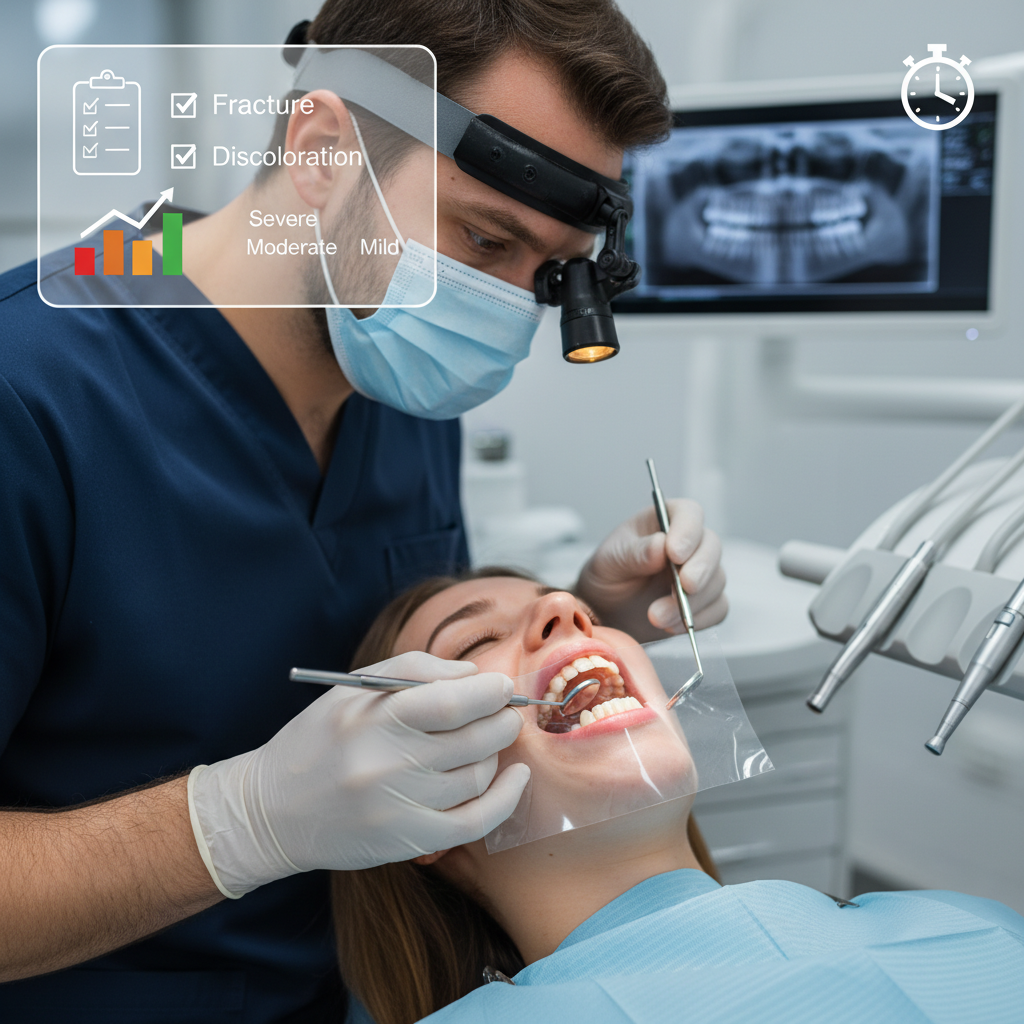
How dentists confirm severity
At the end of the day, you can only estimate severity at home. A dentist has tools to confirm what is really going on beneath the surface.
To assess your injury, your dentist will usually:
- Examine your teeth, gums, lips, and jaw
- Check mobility and how your teeth fit together
- Take dental X rays, and sometimes CT scans, to look for hidden fractures or root damage
Imaging is especially important because many serious injuries are not obvious by sight alone [1].
If you want to prepare for that visit, you can review how to assess dental injury so you know which details to share. The more accurately you describe what happened, the easier it is for your dentist to judge severity and choose the right treatment.
Quick rule of thumb: if the injury changes how your mouth looks, feels, or works, assume it needs at least a professional check, even if it does not feel like an emergency to you.
Urgent vs non urgent: putting it all together
When you are in the moment, it helps to simplify. Instead of trying to remember every detail, ask yourself a few focused questions that reflect how dentists think about what is considered a dental emergency.
You likely need immediate emergency or ER care if:
- Bleeding does not stop after 10 minutes of firm pressure
- You suspect a broken jaw or have severe facial trauma
- You have trouble breathing, swallowing, or opening your mouth
- An adult tooth is completely knocked out
- Pain is severe, sudden, and unrelieved by medication, especially with swelling or fever
You likely need same day or next day urgent dental care if:
- A tooth is loose, pushed in, or out of position
- A large portion of a tooth is broken or deeply cracked
- Your bite suddenly feels off or teeth do not fit together like before
- You have persistent swelling, bruising, or moderate to severe pain
- You notice tooth discoloration after an injury
You can usually schedule a prompt but non emergency visit if:
- You have a small chip with minimal or no pain
- There is mild soreness after a bump, but your bite feels normal
- Minor cuts in the mouth stop bleeding quickly and heal over a day or two
If you are still not sure, check resources like when to go to emergency dentist, dental problems that cannot wait, or what counts as dental emergency symptoms, then call your dentist’s office. They can walk you through your symptoms and tell you if you need to be seen urgently.
Next steps if you are unsure
Deciding how to identify dental trauma severity can feel overwhelming while you are in pain or worried about your smile. You do not need to make that call alone.
Here is a simple way to move forward:
- Quickly scan for red flag symptoms: uncontrolled bleeding, breathing problems, knocked out tooth, suspected broken jaw, or severe swelling. If you see any of these, seek emergency care immediately.
- If there are no red flags, look at pain, bleeding, swelling, and tooth position to decide if the problem sounds more urgent or minor.
- Call your dentist, describe exactly what happened and what you see, and ask directly whether this is an emergency or can wait.
The sooner you reach out, the more options you have. Timely care not only relieves pain, it can save injured teeth and prevent complications. When in doubt, treat your concerns seriously. It is always better to ask and be reassured than to wait and wish you had acted sooner.