Understanding sedation emergency dental care
When you are in pain or facing a sudden dental injury, the idea of sitting through treatment can feel overwhelming. Sedation emergency dental care uses medications to help you stay calm, comfortable, and still while your dentist handles urgent problems. This approach supports both your physical comfort and your emotional well‑being, especially if you live with dental anxiety or you need complex or lengthy treatment in a single visit [1].
In many cases, sedation makes it possible for your dentist to complete several procedures at once. That can be critical if you need accelerated repair after trauma, emergency extractions, or cosmetic fixes after an accident. With the right level of sedation, you can get the care you need quickly without a traumatic experience.
When you might need sedated emergency care
Not every dental emergency requires sedation, but certain situations make it a very helpful option. Understanding these scenarios can help you decide what to ask for when you call.
Severe pain or complex procedures
If you have intense pain or need urgent treatment that takes more time, sedation can help you tolerate care that might otherwise feel impossible. Sedation is often considered when you need:
- A sedated tooth extraction emergency, especially for broken or impacted teeth
- Root canal treatment on a severely painful tooth
- Multiple fillings or crowns completed in a single visit
- Emergency implant support or emergency implant repair services after trauma
Sedation allows your dentist to focus on precise work, while you stay relaxed and less aware of the details of the procedure [2].
Dental anxiety, fear, or past trauma
If you avoid the dentist because of fear, you are not alone. It is estimated that around 30 to 40 percent of people feel some level of dental anxiety, which has helped drive interest in sedation dentistry as a solution [3]. In emergencies, that anxiety can rise even higher.
Sedation can be particularly helpful if you:
- Have had painful or negative dental experiences in the past
- Struggle with a strong gag reflex or panic in the dental chair
- Need urgent care but have postponed routine visits for years
- Feel embarrassed about the condition of your teeth
In these situations, it may be appropriate to ask about sedation for anxious emergency patients so that needed care does not feel overwhelming.
Pediatric emergencies and special populations
Children and other vulnerable patients often need additional support in an emergency. Sedation can be an important tool if you are seeking:
- Help for a child tooth trauma emergency
- Treatment from a child-friendly emergency dentist or a pediatric trauma dental clinic
- Care from a pediatric emergency dentist charlotte or similar local provider trained in pediatric sedation
Sedation may also be appropriate for adults with special needs, severe gag reflexes, or medical conditions that make it difficult to sit still for treatment. In addition, older adults may benefit when urgent treatment is needed but chair time must be kept as smooth and low stress as possible, for example through emergency dental for seniors.
Main types of sedation used in emergencies
Sedation in dentistry covers a spectrum, from light relaxation to complete unconsciousness. Your dentist chooses a level that matches your health, the urgency of the problem, and how complex the procedure will be [3].
Nitrous oxide (laughing gas)
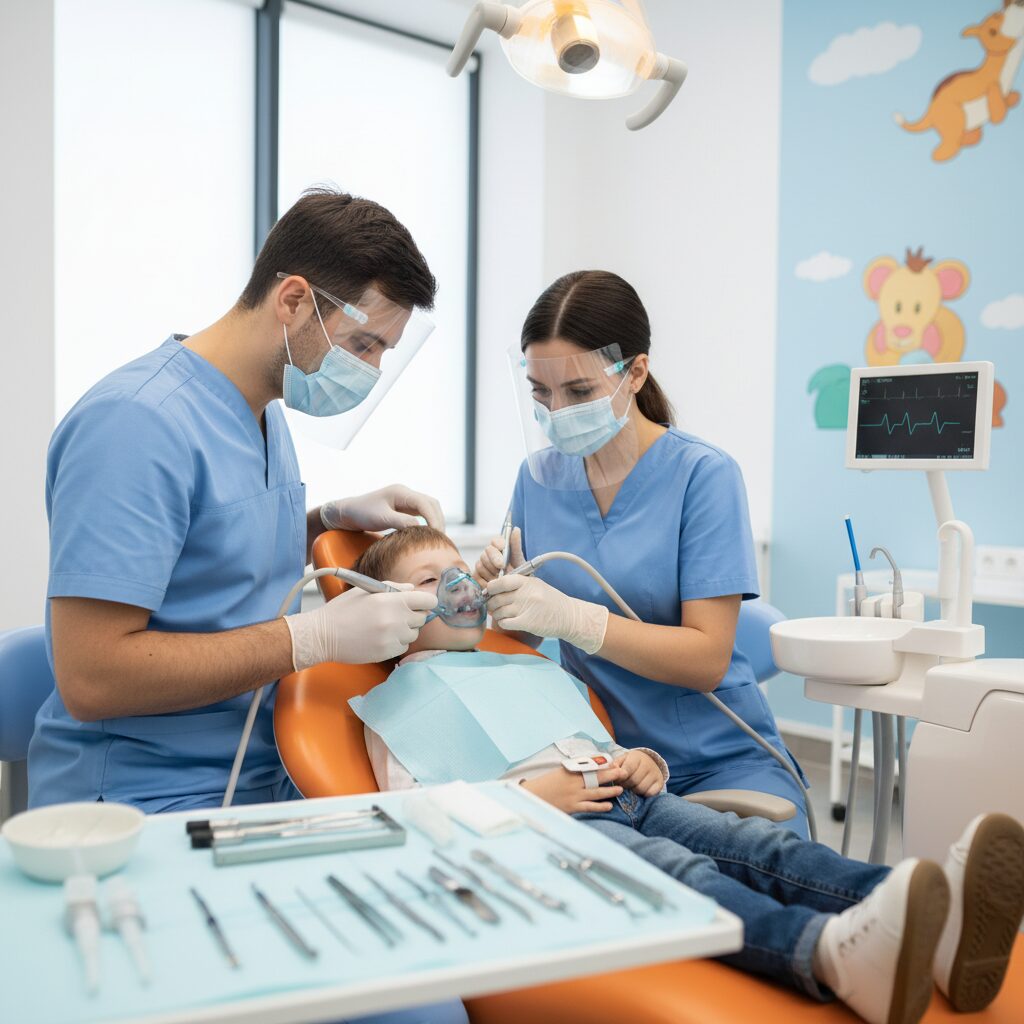
Nitrous oxide is a mild, inhaled sedative delivered through a small mask over your nose. It starts working within 3 to 5 minutes, and it helps you feel relaxed and less worried while staying awake and able to respond to your dentist [4].
Key points about nitrous oxide:
- Often used for quick emergencies like small repairs, minor emergency cosmetic dental repair, or children’s procedures
- Effects wear off very quickly once the gas is stopped
- You can usually drive yourself home and return to normal activities right after treatment [4]
- Often ideal for emergency care for children’s teeth and anxious but cooperative adults
Because it is light and easily controlled, nitrous oxide is frequently the first option considered in both pediatric and adult emergencies.
Oral conscious sedation
Oral conscious sedation is usually provided as a prescription pill that you take before your appointment. Common medications include triazolam, zaleplon, or lorazepam, taken about an hour before treatment [4].
With oral sedation:
- You feel drowsy and very relaxed
- You typically remain awake but may fall lightly asleep
- You might remember little or nothing about the procedure afterward
- You must have someone drive you to and from the appointment, and you should not drive for the rest of the day
Oral sedation can work well if you need longer emergency procedures such as emergency crown for cosmetic need after a break, emergency veneer repair, or complex esthetic fix emergency dentistry.
Intravenous (IV) sedation
IV sedation is the deepest form of conscious sedation commonly used in dental offices. Medication is delivered directly into your bloodstream, and your dentist or anesthesiology provider carefully adjusts the level of sedation as the procedure continues [4].
With IV sedation:
- You are very relaxed and may fall asleep
- You are unlikely to remember much of the procedure
- Your heart rate, blood pressure, and breathing are monitored continuously
- It is well suited for severe anxiety, longer surgeries, or multiple treatments at once
IV sedation is often considered for difficult extractions, urgent implant placement, or complex combined care, and it is sometimes part of sedated emergency care charlotte and similar regional services. After IV sedation, you need a responsible adult to drive you home and stay with you for the first part of your recovery [3].
General anesthesia
General anesthesia makes you fully unconscious so you do not feel pain or remember the procedure. In dentistry, it is reserved for large or complex procedures, or for patients who cannot safely receive lighter sedation. It is provided in a controlled setting with specialized monitoring, and recovery typically takes longer [1].
General anesthesia may be recommended if you or your child:
- Need extensive surgery that cannot be done comfortably with lighter sedation
- Have medical or behavioral conditions that make cooperation impossible while awake
- Require multiple major treatments in a single session
Your dentist will work closely with an anesthesiology team and follow strict safety protocols if general anesthesia is used.
What to expect before sedated emergency treatment
Even in urgent situations, sedation dentistry follows specific safety steps. Knowing what to expect can help you feel more prepared when you arrive for care.
Medical history and screening
Your dentist will ask detailed questions about your health, current medications, and allergies. They will also consider your age, weight, and any chronic conditions when planning sedation. Following American Dental Association guidelines, sedation plans are tailored to your individual health profile, and your vital signs are continuously monitored during treatment [5].
You should be ready to share information about:
- Heart or lung disease
- Sleep apnea or breathing problems
- Liver or kidney conditions
- Pregnancy
- Alcohol or substance use
- Any previous issues with anesthesia or sedation
This screening helps your care team choose a sedation type and dose that fits your needs as safely as possible.
Fasting and preparation
Preparation depends on the type of sedation. For nitrous oxide, no major change is usually needed, although a light meal a couple of hours beforehand may be recommended [3]. For oral sedation, IV sedation, or general anesthesia, you are often asked not to eat or drink for 6 to 8 hours before the procedure to reduce the risk of nausea or aspiration [3].
Your dentist will give clear instructions, which may include:
- When to stop eating and drinking
- What medications you should or should not take the morning of your appointment
- Arranging for a driver and support person after the visit
If your emergency is immediate and fasting is not possible, your dentist will weigh the risks and benefits and may adjust the type or depth of sedation accordingly.
How sedation supports pediatric emergency care
For children, emergencies like knocked‑out teeth, deep fractures, or severe infections are frightening events. Sedation can make urgent care much more manageable for both you and your child.
Calming anxious or injured children
Children often struggle to understand why treatment is needed, especially when they are in pain. Sedation can:
- Reduce fear and crying
- Help your child stay still for X‑rays and procedures
- Lower trauma associated with the dental visit
- Allow the dentist to complete more in a single appointment
Nitrous oxide is commonly used in a child-friendly emergency dentist setting, while oral or IV sedation may be considered in a pediatric trauma dental clinic or with a pediatric emergency dentist charlotte, depending on your location and your child’s needs.
Protecting developing teeth and appearance
Quick, comfortable care is vital not only to relieve pain but also to protect long term function and appearance. In many pediatric emergencies, your dentist focuses on:
- Saving damaged permanent teeth whenever possible
- Supporting healthy speech and chewing
- Preserving space for future adult teeth
- Minimizing visible damage to the smile
Sedation often makes it easier to perform treatments that protect both structure and appearance in a single visit, which is especially important in child tooth trauma emergency situations.
Sedation and cosmetic emergency treatments
In many emergencies you are not only worried about pain, you are also concerned about how your smile looks. Sedation can make it easier to complete multiple cosmetic repairs right away, reducing the time you spend feeling self‑conscious.
Restoring your smile after an accident
If you have broken, chipped, or displaced teeth from an injury, you may need a combination of:
- Emergency cosmetic dental repair for visible front teeth
- Cosmetic repair after break with bonding or veneers
- Emergency veneer repair if a veneer is damaged
- Emergency crown for cosmetic need for severely broken teeth
- Esthetic emergency dental care to address both form and function
Sedation can allow your dentist to focus on detail oriented cosmetic work while you remain calm and less aware of the time involved.
Implant and orthodontic emergencies
Cosmetic and functional emergencies also occur with dental implants and orthodontic appliances. You might need:
- Emergency implant support if an implant site becomes painful or damaged
- Emergency implant repair services after trauma to the jaw
- Emergency orthodontic repair for sharp or broken wires and brackets
Mild sedation such as nitrous oxide can be enough for quick orthodontic fixes. More complex implant problems may call for deeper sedation, especially if surgery is required or if you are already in significant pain.
Safety, monitoring, and common medications
Sedation emergency dental care is designed around safety. Your dentist and their team are trained to deliver and monitor sedation medications and to manage rare complications.
How your safety is protected
Throughout your sedated procedure, your care team will monitor:
- Heart rate
- Blood pressure
- Oxygen levels
- Breathing pattern
Dentists follow American Dental Association recommendations to mitigate risk, including having emergency medications and equipment easily accessible [5]. Your vital signs are checked regularly, and sedation levels are adjusted as needed.
Common sedative medications
Several medications are used for conscious sedation in dentistry, each with specific strengths:
- Benzodiazepines such as midazolam are widely used for light to moderate sedation and are considered safe and effective across several administration routes, including oral, intranasal, and intravenous [6]
- Intranasal ketamine can provide deeper sedation than midazolam, although some routes of ketamine administration have been linked to more side effects [6]
- Intravenous propofol at appropriate doses is another option for sedation, although it may cause sudden movements or changes in blood pressure in some patients [6]
- Other agents, such as dexmedetomidine and clonidine, have shown promise as safe alternatives to traditional sedatives but require further research to confirm their role in routine practice [6]
Your dentist or anesthesiology provider selects medications based on the procedure type, your medical history, and how quickly they need the sedation to start and wear off.
Possible risks and side effects
Like any medical treatment, sedation carries some risk. Serious complications are rare when protocols are followed, but you should be aware of common short term effects and how your dentist manages them.
Temporary side effects
After sedation, you might experience:
- Drowsiness or feeling “foggy” for several hours
- Mild nausea
- Dry mouth
- Headache
Most patients return to normal activities within 24 hours, especially when lighter forms of sedation like nitrous oxide are used [5]. With stronger sedation, you may need to rest for the remainder of the day.
Some sedatives, including benzodiazepines, propofol, and nitrous oxide, have been associated occasionally with unusual experiences such as hallucinations, which is one reason your dental team is trained to respond to unexpected reactions [6].
How dentists reduce risk
To limit risk, sedation emergency dental care relies on:
- Careful health screening before treatment
- Adhering to fasting guidelines when needed
- Choosing the lowest effective level of sedation
- Continuous monitoring of vital signs
- Staff training in airway management and emergency response
This structured approach makes sedation dentistry a safe option for most healthy patients, as well as many people with managed medical conditions when appropriate precautions are taken.
Aftercare and recovery at home
Recovery instructions are an important part of safe sedation emergency dental care. Following them closely helps you avoid complications and supports healing.
Immediately after your visit
Depending on the type of sedation, your team may ask you to:
- Rest in the office until you are awake enough to go home
- Use a wheelchair or assistance when walking to the car after deeper sedation
- Avoid driving, operating machinery, or making big decisions until at least the next day if you received oral or IV sedation [3]
You should have a responsible adult with you at home for the first several hours after stronger sedation so they can help you with medications, food, and monitoring.
Caring for yourself at home
At home, you will be given instructions that may include:
- Drinking plenty of water once you are allowed to have fluids
- Eating soft foods for a short time after certain procedures
- Taking prescribed pain medications and antibiotics as directed
- Avoiding alcohol and unapproved medications that might interact with the sedatives
- Watching for signs of problems, such as heavy bleeding, severe swelling, or difficulty breathing
Most people feel back to normal the next day, although it is common to feel a bit more tired than usual. If nausea, dizziness, or heavy grogginess last longer than 24 hours, you should contact your dentist, as recommended in sedation guidelines [4].
If you are ever unsure whether a symptom is normal after sedation, it is safer to call your dentist or seek urgent care than to wait and worry at home.
Using this guide in a real emergency
When a dental emergency happens, it is easy to feel rushed and unsure what to ask for. Keeping a few simple points in mind can help you advocate for yourself or your child:
- Tell the dentist honestly about any anxiety, past experiences, or health conditions
- Ask if nitrous oxide, oral sedation, or IV sedation might make the procedure more manageable
- If your emergency involves a child, look for a child-friendly emergency dentist or pediatric emergency dentist charlotte style provider in your area who has experience with pediatric sedation
- For visible damage to front teeth, ask about esthetic emergency dental care and cosmetic repair after break, and whether sedation can help complete more work in one visit
With the right plan, sedation emergency dental care can turn a frightening, painful situation into a controlled, manageable experience that protects your health and your smile.