A sudden toothache or cracked tooth can be confusing. You might wonder if you are facing a true dental emergency or something that can wait a few days. Understanding common dental emergency warning signs helps you act quickly when it really matters, and avoid unnecessary panic when it does not.
This guide walks you through what counts as urgent, which symptoms to watch closely, and when you should get help right away.
What counts as a dental emergency
A dental emergency is any problem with your teeth, gums, or jaw that requires immediate attention to stop severe pain, control bleeding, prevent infection, or save a tooth.
According to Cleveland Clinic, emergencies include issues like uncontrolled bleeding, pain that is not relieved by medication, and injuries with possible broken facial bones that may even need hospital-level care [1]. If you are unsure what falls into this category, you can also review what is considered a dental emergency.
You should treat something as urgent if:
- The pain is severe or getting rapidly worse
- You notice swelling in your face or jaw
- You cannot chew, swallow, or open your mouth normally
- A tooth is knocked out or badly broken
- Bleeding will not slow down after 10 to 15 minutes of pressure
If your situation does not seem to fit any of these, it may be a non urgent issue, which you can compare in more detail in urgent vs non urgent dental issues.
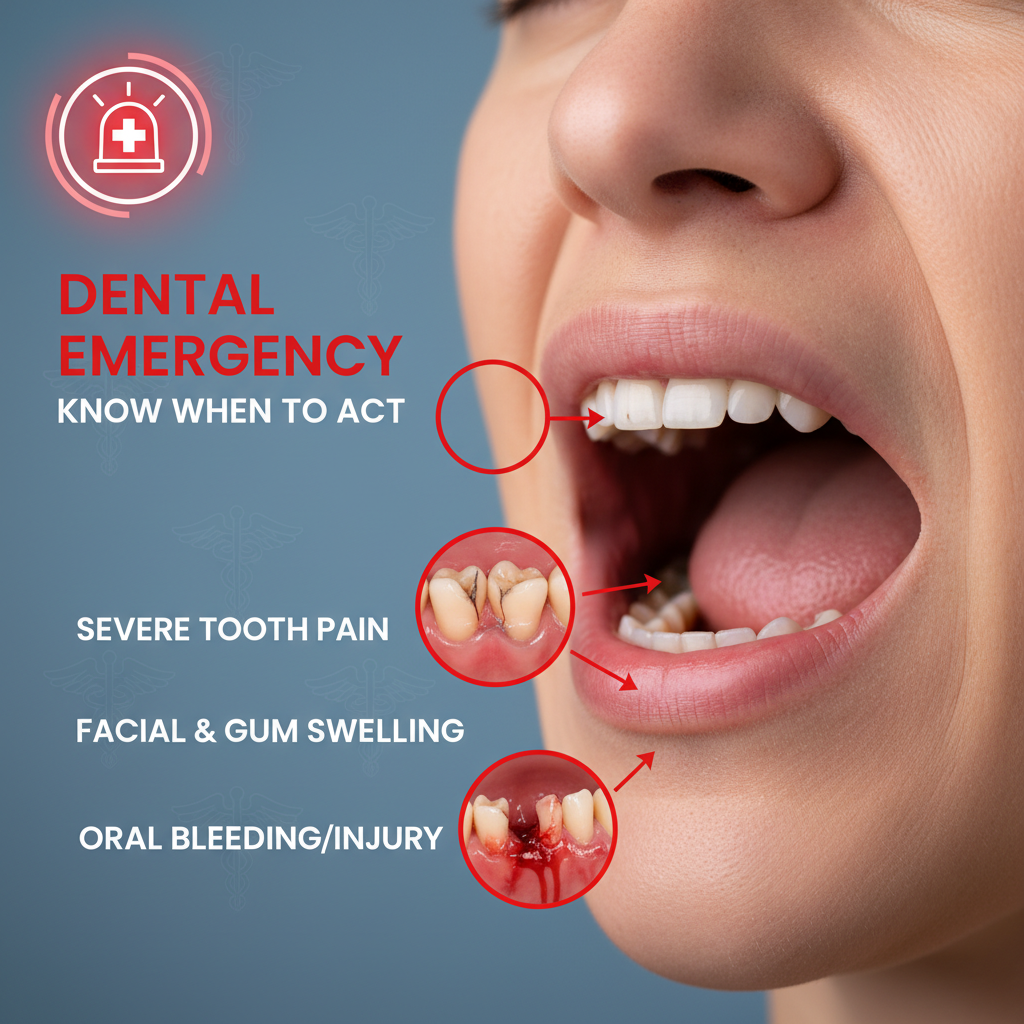
Severe tooth pain that will not go away
Tooth pain is one of the clearest dental emergency warning signs, especially when it is intense or constant. Mild discomfort that comes and goes can often wait for a scheduled visit. Pain that keeps you from sleeping or eating usually cannot.
Cleveland Clinic suggests rinsing with warm water, flossing to remove food debris, using a cold compress, and taking over the counter pain relievers like acetaminophen, ibuprofen, or naproxen for a severe toothache. You should avoid placing aspirin directly on your gums because it can irritate tissue [1].
However, if pain does not improve or keeps coming back, that is a signal to stop guessing and call a dentist. Multiple sources, including Smile Savers Dentistry, Modern Dental, and Juanita Family Dentistry, agree that severe toothache not relieved by over the counter medication is a dental emergency and needs immediate evaluation [2].
If you tend to minimize your pain, it can help to read more detailed guidance on how serious is tooth pain and how to know if tooth pain is emergency.
Cracked, broken, or chipped teeth
You might be tempted to ignore a small crack or chip, especially if it does not hurt much. Unfortunately, teeth do not heal cracks on their own. They can worsen with chewing and eventually lead to infection.
The Cleveland Clinic explains that a cracked tooth often causes pain, swelling, and sensitivity to hot or cold. These symptoms mean the inner layers of the tooth may be exposed and at risk for infection [3]. Cracked tooth syndrome most often affects upper front teeth and lower molars, so cracks in these areas deserve special attention [3].
MKR Dental notes several specific warning signs that your cracked or broken tooth needs urgent care:
- Pain when chewing, especially when you release pressure
- Sensitivity to hot, cold, or sweet foods
- Intermittent sharp pain
- Swelling around the tooth
- Visible fracture lines or a missing piece of tooth [4]
Ignoring these can lead to deepening cracks, infection, and even tooth loss [4]. For help sorting out your specific situation, check out tooth damage emergency vs minor, is a cracked tooth a dental emergency, and is a chipped tooth an emergency.
Knocked out or suddenly loose adult teeth
A knocked out tooth is one of the clearest dental emergencies. Time matters. Cleveland Clinic advises gently rinsing the tooth root without scrubbing, trying to place the tooth back into the socket if you can, or storing it in milk or saltwater. Then you should see a dentist within one hour for the best chance to save the tooth [1].
Modern Dental and Juanita Family Dentistry echo this advice. If an adult tooth is knocked out by trauma, you need immediate dental attention. Until you get there, they recommend keeping the tooth in milk or gently placing it back in the socket without forcing it [5].
A tooth that becomes loose on its own, without clear injury, is also a warning sign. Smile Savers Dentistry notes that loose adult teeth or unexplained missing teeth can signal decay, gum disease, or infection. These problems need prompt evaluation and often X rays to prevent further damage [6].
If you are dealing with trauma to the mouth or face, you can learn more about how to identify dental trauma severity and how to assess dental injury.
Swelling, infections, and abscesses
Swelling in your gums, jaw, or face combined with pain is rarely something to ignore. These are classic dental emergency warning signs because they can point to infection, including a tooth abscess.
A tooth abscess is a pocket of pus caused by bacteria at the tooth root or in the gums. Rowlett Dental Associates notes that abscesses often result from untreated cavities, gum disease, or injuries, and they are considered emergencies because they will not heal on their own and can spread to the jaw, neck, or bloodstream [7]. Effective treatment usually involves draining the abscess, antibiotics, and possibly a root canal or extraction [7].
Smiles By The Sea Family Dentistry highlights early signs of tooth infection that you should not brush off:
- Dull or sharp pain when biting
- Sensitivity to hot or cold that causes shooting pain
- Swelling or puffiness in the gums or face
- Bad breath or a foul taste
- Tooth discoloration that may mean pulp damage [8]
Red flag symptoms that require immediate emergency care include:
- Dental pain with a fever higher than 100.4°F
- Difficulty swallowing or breathing
- Swelling that spreads toward your eyes or neck
- Severe pain from a rapidly forming abscess that does not improve with over the counter medication [8]
Cleveland Clinic also advises that a dental abscess can cause facial swelling or spread to other areas if untreated, so you should rinse with a mild salt water solution several times a day and see a dentist promptly [1].
Left untreated, infections can lead to serious complications like sepsis, brain abscesses, jaw bone infections, and even heart valve infections, all of which require immediate medical care [8]. For more detail on these situations, see when gum swelling is an emergency and dental problems that cannot wait.
If you have swelling plus fever, trouble breathing, or trouble swallowing, treat it as a medical emergency and go to an emergency room right away.
Bleeding gums and oral injuries
Not all bleeding is an emergency. Mild bleeding when you floss for the first time in a while is common. On the other hand, heavy or unexplained bleeding can signal something more serious.
Smile Savers Dentistry points out that severe gum bleeding and swelling are emergency warning signs that may indicate advanced gum disease or infection. These require immediate care to avoid permanent damage [6].
Juanita Family Dentistry adds that if bleeding after a dental injury lasts more than about 10 minutes despite steady pressure, this can reflect serious injury to the gums or tooth roots and needs prompt attention [9].
Injuries from sports or falls are also considered dental trauma and should be checked quickly, even if they look minor. Juanita Family Dentistry notes that untreated trauma can lead to long term problems with tooth stability and jaw alignment [9]. You can get a clearer picture of these scenarios by reviewing how to assess dental injury and how to identify dental trauma severity.
If you are wondering whether your bleeding is serious, when bleeding gums are serious can help you decide.
Changes in bite, jaw pain, or difficulty moving your mouth
Not every dental emergency comes with obvious pain. Subtle changes in how your teeth fit together or how your jaw moves can also be warning signs.
Juanita Family Dentistry notes that changes in bite alignment or noticeable shifting of teeth can point to gum disease or jaw problems. These issues can progress if ignored, so they should be evaluated quickly [9].
Smile Savers Dentistry also highlights a swollen jaw with pain when opening your mouth or chewing, along with a bad taste in your mouth. These symptoms may signal a salivary gland infection or other serious bacterial infection that requires prompt treatment [6].
If your jaw feels stiff, painful, or misaligned after an accident, or if you suspect broken facial bones, Cleveland Clinic recommends going to an emergency room. Some injuries need hospital care beyond what a dental office can provide [1].
When you should go to urgent care or the ER
You might assume any serious tooth problem belongs in the emergency room, but that is not always the best first step. Dr. Troy Madsen, an emergency room physician with University of Utah Health, notes that ER doctors are not trained to perform dental procedures such as extractions. If you can manage the pain at home, he suggests avoiding the ER and seeing a dentist instead [10].
However, the ER is appropriate when:
- You have severe tooth pain that you cannot control with over the counter medication
- You show signs of an abscess with major swelling on the side of the face or down to the neck
- You have difficulty breathing or swallowing
- Infection signs have spread beyond the tooth, especially with high fever or rapidly increasing swelling [11]
In those situations, the ER can provide antibiotics and strong pain relief until you can see a dentist for definitive treatment [10]. For less severe pain outside normal office hours, urgent care centers are another reasonable option, since they can prescribe antibiotics and pain medication as well [10].
If you are weighing your options, you can read more about when to go to emergency dentist and how to decide if you need urgent dental care.
How long you can safely wait
Not every toothache means you need same-day care, but waiting too long can turn a manageable problem into an emergency. Early signs like mild sensitivity to temperature or minor discomfort when chewing are worth monitoring, especially if they persist.
If you notice symptoms such as:
- Increasing pain over several days
- New or worsening swelling
- Pain that suddenly becomes sharp or throbbing
- Fever, fatigue, or general feeling of illness
it is time to move from “wait and see” to “call your dentist.” Tooth infections and cracks can progress silently at first, then worsen quickly. To better understand timelines, look at how long can you wait with tooth pain and when dental pain becomes urgent.
If you already suspect your symptoms match clear warning signs, it can also help to check what dental issues need immediate care and what counts as dental emergency symptoms.
Simple steps you can take right now
If you are reading this because something hurts or feels off, you do not need to have all the answers before you reach out for help. A few simple actions can protect your health while you arrange care:
-
Write down your symptoms
Include when they started, what makes them better or worse, and any changes over time. This makes it easier for your dental team to assess urgency. -
Check for emergency warning signs
Look for severe pain, swelling, fever, trouble breathing or swallowing, uncontrolled bleeding, or a knocked out or very loose tooth. -
Use home care wisely
Rinse gently with warm salt water. Use a cold compress for swelling. Take over the counter pain medication as directed, but do not put aspirin directly on your gums [1]. -
Call a dentist or emergency line
If you are unsure where your situation falls on the urgent spectrum, many offices can help you triage over the phone based on your symptoms. -
Treat red flag symptoms as emergencies
If you notice high fever, rapid swelling in your face or neck, trouble breathing, or trouble swallowing, go to an emergency room immediately [12].
If you like having a reference for the future, you might bookmark resources like signs you need emergency dental care and dental problems that cannot wait.
Key takeaways
- Dental emergency warning signs include severe pain, uncontrolled bleeding, facial or jaw swelling, fever with tooth pain, difficulty breathing or swallowing, and knocked out or very loose teeth.
- Cracked or broken teeth, especially with pain or sensitivity, are urgent because they can lead to infection and long term damage if ignored [13].
- Abscesses and infections are emergencies because they can spread beyond your mouth and cause serious health complications if not treated quickly [14].
- The ER is appropriate when you have severe uncontrolled pain, swelling that affects breathing or swallowing, or signs that infection is spreading, while many other urgent problems are best handled by a dentist or urgent care.
- When in doubt, call a dental office and describe your symptoms. It is better to ask early than to wait until a small problem becomes a true emergency.
You do not have to decide everything on your own. If something feels wrong, trust that instinct, reach out for guidance, and let a professional help you figure out the next right step.
References
- (Cleveland Clinic)
- (Smile Savers Dentistry, Modern Dental, Juanita Family Dentistry)
- (Cleveland Clinic)
- (MKR Dental)
- (Modern Dental, Juanita Family Dentistry)
- (Smile Savers Dentistry)
- (Rowlett Dental Associates)
- (Smiles By The Sea Family Dentistry)
- (Juanita Family Dentistry)
- (University of Utah Health)
- (University of Utah Health, Smiles By The Sea Family Dentistry)
- (Smiles By The Sea Family Dentistry, University of Utah Health)
- (Cleveland Clinic, MKR Dental)
- (Rowlett Dental Associates, Smiles By The Sea Family Dentistry)